
Testosterone Through the Decades: How Levels Naturally Shift with Age

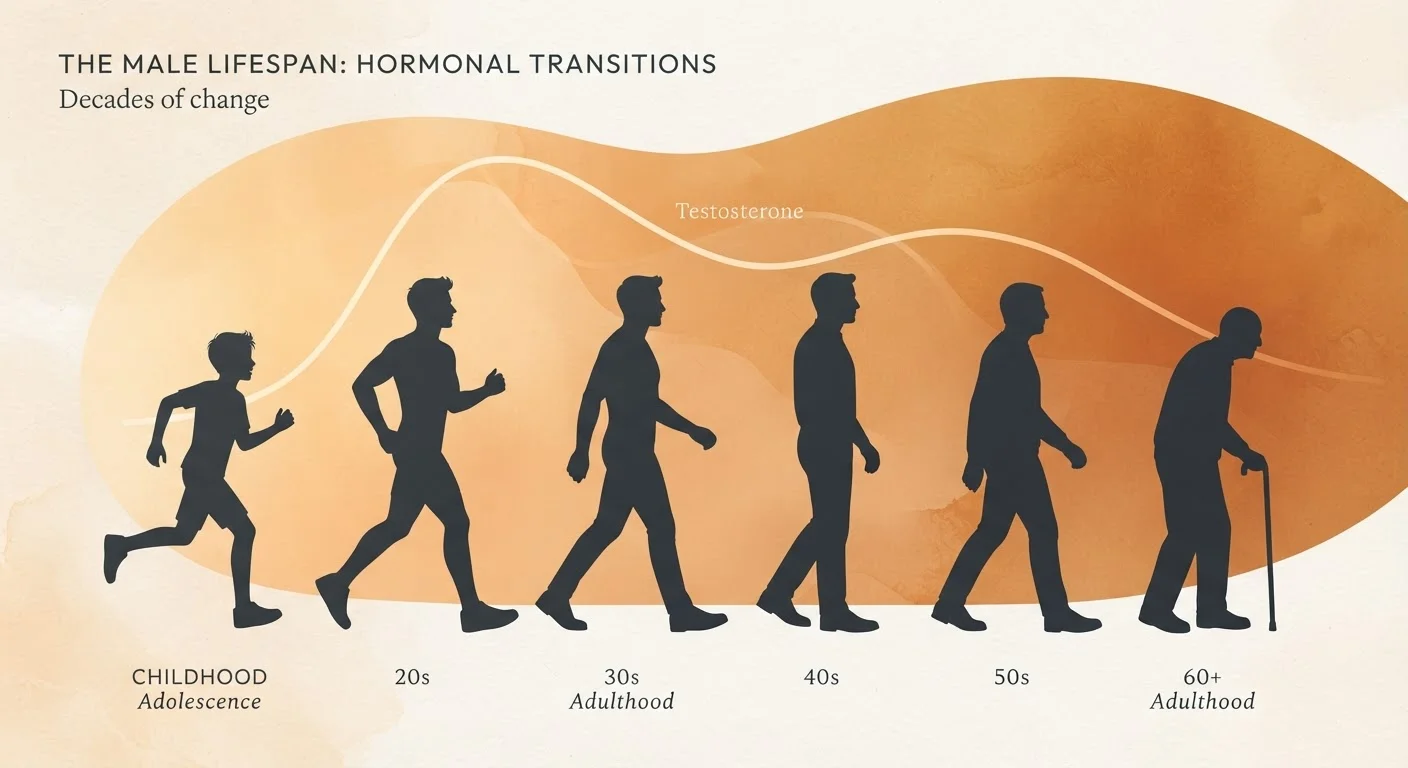
Photo: FeaturingHealth.net | Healthy Living Simplified editorial
The Natural Arc of Testosterone Production
Testosterone doesn't follow a flat line through a man's life. It surges during puberty, peaks in early adulthood, and then begins a gradual, largely predictable decline. Understanding this arc is essential context for interpreting how you feel at any given age — and for knowing when a change might be worth discussing with a doctor.
Testosterone is produced primarily in the Leydig cells of the testes, with a smaller contribution from the adrenal glands. The hypothalamus and pituitary gland regulate its release through a feedback loop involving luteinizing hormone (LH) and follicle-stimulating hormone (FSH). This system is sensitive to stress, sleep quality, body composition, and overall health — meaning testosterone levels reflect far more than just age. For a deeper look at what this hormone actually does in the body, see what testosterone actually does.
Decade by Decade: What Research Shows
20s: The Peak Window
Total testosterone generally reaches its highest levels in the late teens and early-to-mid 20s. Reference ranges from major clinical bodies typically place normal total testosterone for adult men between approximately 300 and 1,000 ng/dL, though labs may vary slightly. Most men in this decade fall comfortably in the upper portion of that range.
30s: The Gradual Decline Begins
Research consistently shows that testosterone begins declining at roughly 1–2% per year after age 30. This rate is modest enough that most men notice nothing at all. However, cumulative lifestyle factors — obesity, poor sleep, chronic stress, and sedentary behavior — can steepen the curve beyond the typical trajectory.
40s and 50s: More Noticeable Shifts
By the mid-40s to 50s, some men begin to experience symptoms that may correlate with lower testosterone: reduced energy, changes in body composition, shifts in mood, or decreased libido. It is important to note that these symptoms have many possible causes and are not automatically indicative of low testosterone. Common myths about male hormones can make it harder to interpret these changes accurately. If you're adapting your exercise routine during this period, strength training in your 40s offers evidence-based guidance.
60s and Beyond: Late-Life Levels
Testosterone continues its gradual decline into the 60s and 70s. Some decline at this stage is considered a normal part of aging — sometimes called "late-onset hypogonadism" when accompanied by clinical symptoms — but significant drops are not universal and should not be assumed inevitable.
~1–2%
Annual testosterone decline after age 30
Reported across multiple longitudinal studies, including the Massachusetts Male Aging Study.
~20–30%
Estimated total decline from age 30 to 70
Based on population-level data; individual variation is significant and influenced by lifestyle factors.
2–6%
Prevalence of symptomatic hypogonadism in men aged 40–79
According to the European Male Ageing Study (EMAS), published in the New England Journal of Medicine, 2010.
When to Talk to a Doctor
A single low reading doesn't define hypogonadism. Clinical guidelines recommend at least two morning blood draws — when testosterone is naturally at its daily peak — before drawing conclusions. Symptoms matter as much as numbers; treatment decisions are made on the combination of both.
Total testosterone
The combined measure of testosterone that is bound to proteins and free in the bloodstream. Most standard blood tests report this value, though free testosterone may provide additional clinical insight.
Free testosterone
The portion of testosterone not bound to sex hormone-binding globulin (SHBG) or albumin. It is the biologically active fraction that cells can readily use.
Hypogonadism
A clinical condition in which the testes do not produce sufficient testosterone or sperm, confirmed by both laboratory results and symptoms. Diagnosis requires medical evaluation.
SHBG (Sex Hormone-Binding Globulin)
A protein produced by the liver that binds to testosterone in the blood, making it temporarily inactive. SHBG levels tend to rise with age, which can lower the amount of bioavailable testosterone.
Late-onset hypogonadism
A term used to describe age-related testosterone decline accompanied by clinical symptoms such as reduced libido, fatigue, and mood changes. It is not considered a universal or inevitable part of aging.
If you're experiencing persistent fatigue, significant mood changes, sexual dysfunction, or unexplained loss of muscle mass, these warrant a conversation with a healthcare provider — not self-diagnosis or supplementation. Hormonal changes are not exclusive to men, and context always shapes interpretation.
This article is for general informational purposes only and does not constitute medical advice. Always consult a qualified healthcare professional regarding any health concerns or before making changes to your care.
The content on this site is for informational purposes only and is not a substitute for professional advice. Always consult a qualified professional for guidance specific to your situation.