
Dietary Fat: Why Your Body Needs It and What Happens When You Avoid It

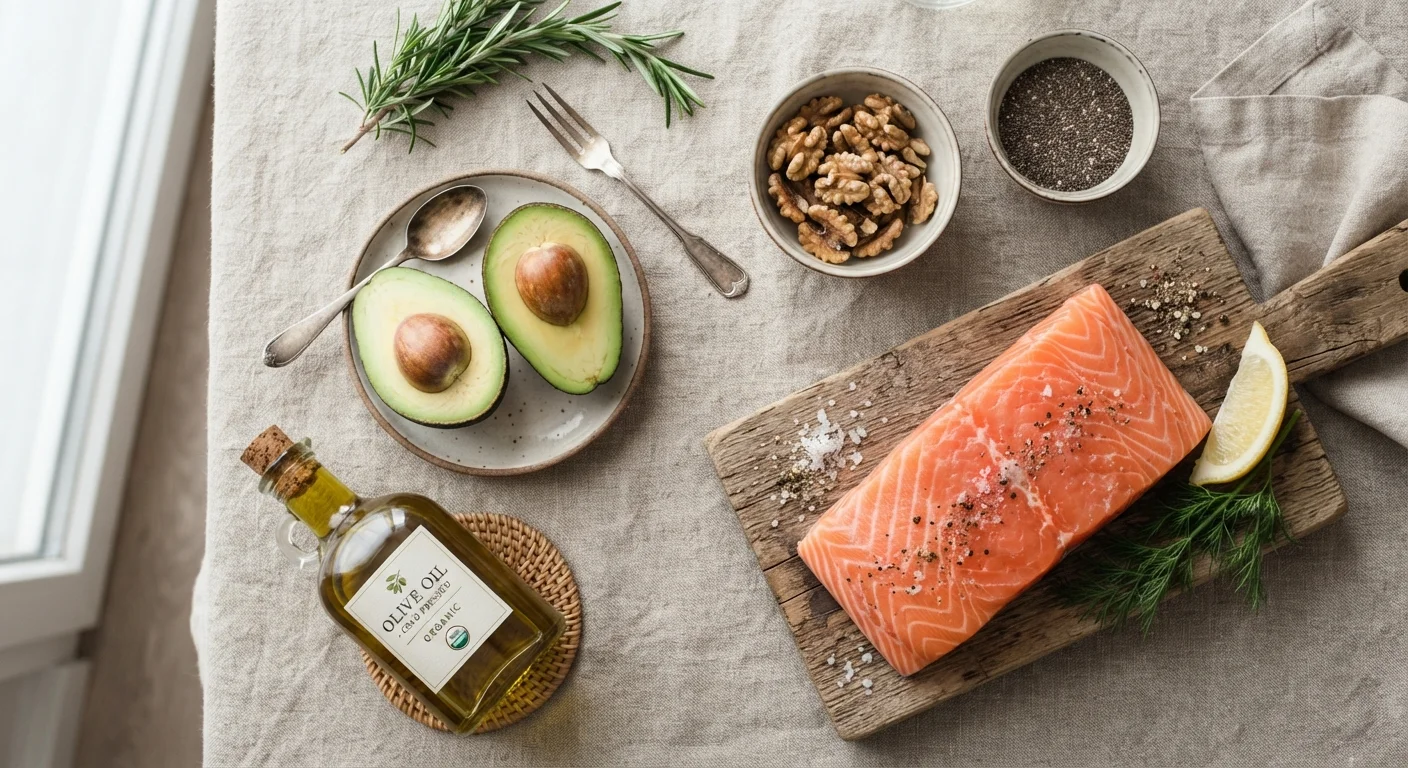
Photo: FeaturingHealth.net | Healthy Living Simplified editorial
Key Takeaways
- Dietary fat is a required macronutrient — cutting it out entirely harms your health.
- Fat enables absorption of vitamins A, D, E, and K, which are fat-soluble.
- Unsaturated fats support heart health; trans fats are linked to cardiovascular risk.
- Very low-fat diets can disrupt hormone production and brain function.
- Portion size and fat type matter more than avoiding fat altogether.
Essential for absorbing fat-soluble vitamins
Vitamins A, D, E, and K require dietary fat to be absorbed in the small intestine. Without adequate fat, even a micronutrient-rich diet can leave these vitamins poorly utilized.
Supports hormone production
Steroid hormones — including estrogen, testosterone, and cortisol — are synthesized from cholesterol, which depends on adequate fat intake. Severely restricting fat can suppress hormonal output.
Critical for brain structure and function
The brain is largely composed of fat, and omega-3 fatty acids like DHA are integral to neuronal membrane integrity and communication. Adequate dietary fat supports cognitive health over time.
Provides sustained energy between meals
Fat is a slow-releasing fuel source that helps stabilize blood sugar and extend satiety, which can reduce the impulse to snack on high-sugar foods.
Unsaturated fats support cardiovascular health
Research consistently links higher intake of monounsaturated and polyunsaturated fats — from sources like olive oil and fatty fish — with better blood lipid profiles and lower inflammation markers.
High caloric density requires mindful portioning
At 9 calories per gram, fat is more than twice as calorie-dense as protein or carbohydrates. Eating large quantities of even healthy fats without awareness can make it easy to exceed overall calorie needs.
Trans fats are linked to cardiovascular disease
Partially hydrogenated oils — the source of artificial trans fats — raise LDL (low-density lipoprotein) cholesterol and lower HDL (high-density lipoprotein) cholesterol, a pattern strongly associated with heart disease risk.
Excess saturated fat may raise LDL cholesterol
Dietary guidelines from institutions like the American Heart Association advise limiting saturated fat, as high intake is associated with elevated LDL levels in many individuals, a recognized cardiovascular risk factor.
Some processed foods disguise unhealthy fat sources
Packaged snacks, fried foods, and baked goods may contain saturated or residual trans fats that are easy to overlook when reading labels, making it important to check ingredient lists, not just nutrition facts panels.
What Dietary Fat Actually Does in the Body
Fat is one of three macronutrients — alongside carbohydrates and protein — that the body requires to function. For a fuller overview of how all three work together, see Macronutrients Explained. Unlike micronutrients, which are needed in small amounts, fat must be consumed in meaningful quantities to support several non-negotiable physiological processes.
At the cellular level, fat forms the structural backbone of every cell membrane in the body. Without adequate fat, cells cannot maintain the flexible, semi-permeable membranes needed to regulate what enters and exits them. Fat also serves as the primary fuel source during low-intensity, sustained activity and provides a dense energy reserve — roughly 9 calories per gram, compared to 4 calories per gram from carbohydrates or protein.
Perhaps most critically, fat enables the absorption of fat-soluble vitamins: A, D, E, and K. These vitamins require dietary fat to be absorbed through the intestinal wall. Eating a meal rich in leafy greens but containing almost no fat means much of the vitamin K and beta-carotene (a precursor to vitamin A) passes through without being absorbed. To understand how this absorption process differs across vitamin types, see our guide on fat-soluble vs. water-soluble vitamins.
Essential for absorbing fat-soluble vitamins
Vitamins A, D, E, and K require dietary fat to be absorbed in the small intestine. Without adequate fat, even a micronutrient-rich diet can leave these vitamins poorly utilized.
Supports hormone production
Steroid hormones — including estrogen, testosterone, and cortisol — are synthesized from cholesterol, which depends on adequate fat intake. Severely restricting fat can suppress hormonal output.
Critical for brain structure and function
The brain is largely composed of fat, and omega-3 fatty acids like DHA are integral to neuronal membrane integrity and communication. Adequate dietary fat supports cognitive health over time.
Provides sustained energy between meals
Fat is a slow-releasing fuel source that helps stabilize blood sugar and extend satiety, which can reduce the impulse to snack on high-sugar foods.
Unsaturated fats support cardiovascular health
Research consistently links higher intake of monounsaturated and polyunsaturated fats — from sources like olive oil and fatty fish — with better blood lipid profiles and lower inflammation markers.
What Happens When You Severely Restrict Fat
Very low-fat diets — those providing less than roughly 15–20% of total calories from fat — were popularized in the 1980s and 1990s based on early research linking dietary fat to heart disease. The reality proved more nuanced. When fat intake drops sharply, several downstream effects can follow.
Hormone disruption: Dietary fat is a precursor to steroid hormones, including estrogen and testosterone. Chronically low fat intake has been associated with hormonal irregularities. The relationship between fat, body composition, and hormonal health is explored in more depth in Insulin, Testosterone, and Body Fat.
Impaired brain function: Roughly 60% of the brain's dry weight is fat. Docosahexaenoic acid (DHA), an omega-3 fatty acid, is essential for maintaining neural structure and signaling. Diets low in total fat are often also low in these critical omega-3s.
Vitamin deficiencies: As noted above, fat-soluble vitamins cannot be absorbed without fat. Even if micronutrient intake on paper looks adequate, bioavailability can fall short in a very low-fat eating pattern. For a broader look at what micronutrients do, see Vitamins and Minerals: What They Actually Do.
High caloric density requires mindful portioning
At 9 calories per gram, fat is more than twice as calorie-dense as protein or carbohydrates. Eating large quantities of even healthy fats without awareness can make it easy to exceed overall calorie needs.
Trans fats are linked to cardiovascular disease
Partially hydrogenated oils — the source of artificial trans fats — raise LDL (low-density lipoprotein) cholesterol and lower HDL (high-density lipoprotein) cholesterol, a pattern strongly associated with heart disease risk.
Excess saturated fat may raise LDL cholesterol
Dietary guidelines from institutions like the American Heart Association advise limiting saturated fat, as high intake is associated with elevated LDL levels in many individuals, a recognized cardiovascular risk factor.
Some processed foods disguise unhealthy fat sources
Packaged snacks, fried foods, and baked goods may contain saturated or residual trans fats that are easy to overlook when reading labels, making it important to check ingredient lists, not just nutrition facts panels.
Low-Fat Doesn't Mean High-Nutrient
Fat Type Is the Variable That Matters Most
Not all dietary fats behave the same way in the body. The distinction between saturated, unsaturated, and trans fats is critical for understanding which foods to prioritize and which to limit. For a detailed breakdown by type, see Saturated, Unsaturated, and Trans Fats: Sorting Out the Differences.
In practical terms:
- Unsaturated fats (found in olive oil, avocados, nuts, and fatty fish) are associated with favorable effects on blood lipids and inflammation markers.
- Saturated fats (found in red meat, butter, and full-fat dairy) are appropriate in moderate amounts for most adults, though current dietary guidelines suggest keeping intake below 10% of total daily calories.
- Trans fats (primarily from partially hydrogenated oils) have no established safe level and have largely been removed from the U.S. food supply following regulatory action, though small amounts remain in some processed foods.
20–35%
Recommended fat share of total daily calories
The Dietary Guidelines for Americans recommend that adults obtain 20–35% of total daily calories from fat, with an emphasis on unsaturated sources.
60%
Proportion of brain dry weight that is fat
Estimates from neuroscience research indicate the brain's dry weight is approximately 60% fat, underscoring why dietary fat supports neurological function.
The practical takeaway: replacing saturated fat with refined carbohydrates — a common outcome of low-fat diets — does not improve cardiovascular outcomes. Replacing it with unsaturated fat does. The goal is fat quality, not fat elimination.
This article is for general informational and educational purposes only and is not a substitute for professional medical or dietary advice. Consult a registered dietitian or qualified healthcare provider for guidance specific to your health needs.
The content on this site is for informational purposes only and is not a substitute for professional advice. Always consult a qualified professional for guidance specific to your situation.