
Natural Immunity vs. Vaccine-Induced Immunity: A Scientific Comparison

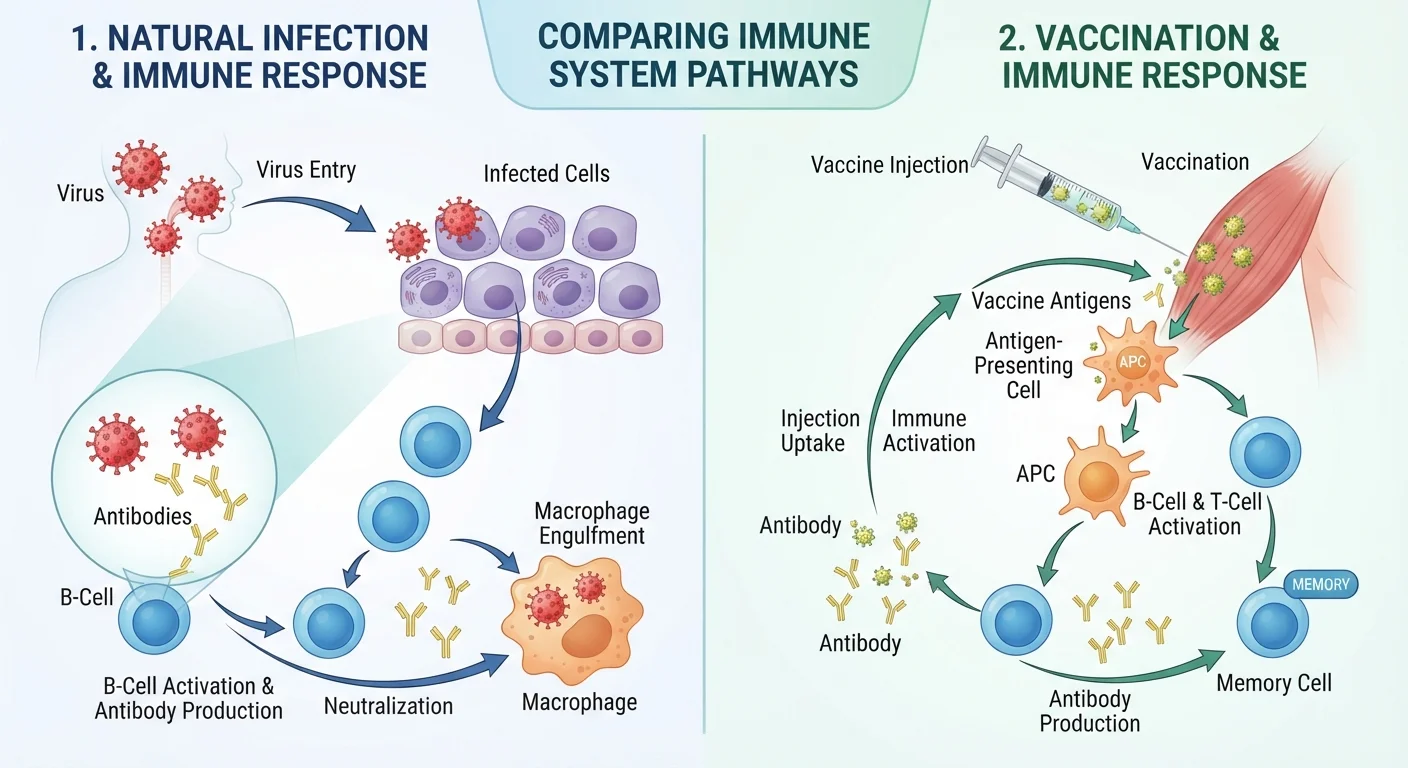
Photo: FeaturingHealth.net | Healthy Living Simplified editorial
Key Takeaways
- Both natural infection and vaccination produce antibodies and memory cells, but through very different risk profiles.
- Natural immunity varies widely by individual, pathogen, and severity of illness, making it unpredictable as a strategy.
- Vaccines are engineered to elicit consistent, measurable immune responses without the dangers of active infection.
- For several pathogens, vaccine-induced immunity meets or exceeds the durability of natural immunity.
- Current clinical guidelines do not recommend seeking infection as a substitute for vaccination.
How Each Type of Immunity Is Built
The immune system uses the same fundamental machinery regardless of whether it encounters a live pathogen or a vaccine antigen. When either arrives, innate immune cells sound the alarm, triggering an adaptive response in which B cells produce antibodies and T cells learn to recognize and destroy infected cells. Over days to weeks, some of those activated lymphocytes mature into long-lived memory cells — the biological basis of lasting immunity.
Natural immunity develops after the immune system mounts a full response to an actual infection. Vaccine-induced immunity uses a controlled trigger — an inactivated virus, a protein subunit, or genetic instructions (as with mRNA vaccines) — to elicit that same adaptive response without exposing the body to a replicating pathogen. For a closer look at what unfolds at the cellular level after vaccination, see how the immune system responds to a vaccine.
Comparing Durability and Breadth of Protection
| Natural Immunity | Vaccine-Induced Immunity | |
|---|---|---|
| How it is acquired | Surviving active infection | Controlled antigen exposure via vaccine |
| Consistency of response | Varies with disease severity and individual | Standardized; engineered for reliable response |
| Risk to acquire | Full disease burden, potential complications | Minimal; established safety profile from trials |
| Durability | Pathogen-dependent; highly variable | Pathogen-dependent; booster schedules address waning |
| Measurability in clinic | Difficult; no standard routine test | Immune response validated in clinical trials |
| Recommended by guidelines | Not recommended as deliberate strategy | Recommended universally per CDC/ACIP schedules |
Durability differs considerably by pathogen. Natural measles infection, for example, typically produces lifelong immunity — as does the MMR vaccine. For influenza, both natural infection and annual vaccination confer short-lived protection because the virus mutates rapidly. COVID-19 research has shown that immunity following severe infection can be robust, yet it is not uniformly superior to vaccination; studies published in journals including Science and Nature found that mRNA vaccines produced high and consistent antibody titers, while natural-infection antibody levels varied dramatically with disease severity.
Breadth of protection — the ability to neutralize variants — also varies. Some vaccines are formulated to target conserved viral regions, potentially offering broader coverage than immunity acquired from a single-strain infection.
~95%
MMR vaccine efficacy against measles
The CDC reports two-dose MMR vaccination is approximately 97% effective, consistent with immunity from natural infection but without the disease risk.
Wide variation
COVID-19 natural antibody levels by severity
Research published in Nature found antibody titers after natural COVID-19 infection varied by orders of magnitude depending on illness severity.
The Critical Risk Difference
This is where the comparison shifts most decisively. Natural immunity requires surviving the disease. That means accepting the full spectrum of illness severity, including serious complications, long-term sequelae, and, for some pathogens, death. Chickenpox, for instance, produces strong natural immunity — but the primary infection carries risks of bacterial superinfection, encephalitis, and later reactivation as shingles. The varicella vaccine provides comparable protection and sidesteps those outcomes entirely.
Vaccines are tested in large clinical trials specifically to characterize their safety profile before authorization. Serious adverse events occur at far lower rates than the complications associated with natural infection for the same pathogen. This risk asymmetry is a core reason clinical guidelines uniformly recommend vaccination rather than deliberate exposure.
Never Seek Deliberate Infection for Immunity
What the Evidence Says About Combined or "Hybrid" Immunity
A body of research, much of it emerging from COVID-19 studies, has examined what scientists call hybrid immunity — the immune response in people who have both been infected and vaccinated. Multiple peer-reviewed analyses found that individuals with hybrid immunity showed particularly high antibody levels and broad neutralizing activity. Importantly, researchers note this does not mean infection is desirable; the vaccine component of that combination remains the controllable, low-risk element.
Clinical bodies including the CDC continue to recommend vaccination regardless of prior infection history for most pathogens, because natural immunity levels are difficult to measure in routine clinical settings and wane at unpredictable rates in different individuals. For a full breakdown of recommended schedules across the lifespan, see recommended immunization timelines. Common misconceptions about this topic are also addressed in our examination of vaccine myths and evidence.
This article is for general informational and educational purposes only and does not constitute medical advice. Talk with a qualified healthcare provider about your personal vaccination needs, especially if you have a chronic condition, are pregnant, or are making decisions for a child or older adult.
The content on this site is for informational purposes only and is not a substitute for professional advice. Always consult a qualified professional for guidance specific to your situation.