
When 'Healthy' Labels on Food Packaging Actually Mean Very Little

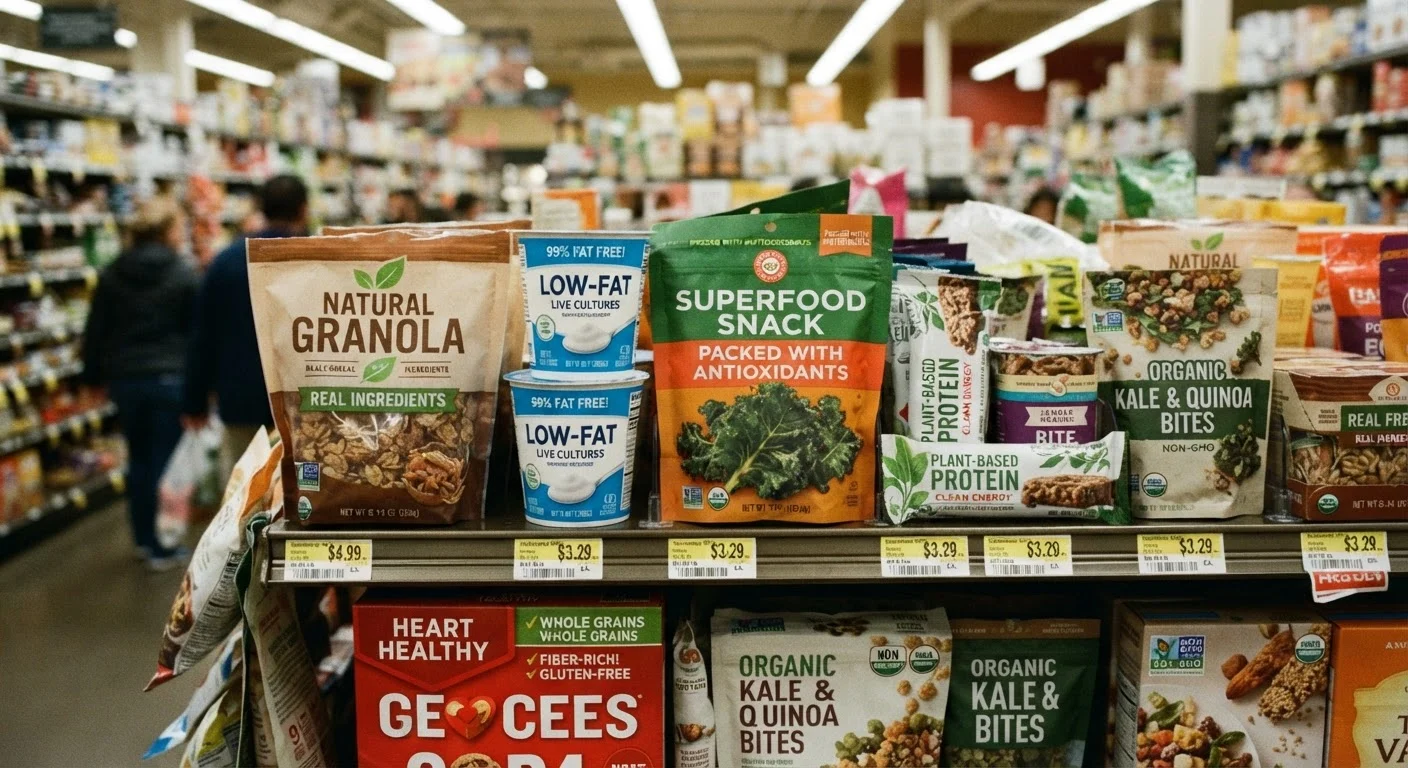
Photo: FeaturingHealth.net | Healthy Living Simplified editorial
Key Takeaways
- Terms like 'natural' and 'superfood' have no standardized FDA regulatory definition.
- Low-fat and reduced-sugar claims can mask other nutritional trade-offs in a product.
- The Nutrition Facts panel on the back of the package is a more reliable information source.
- Marketing language on packaging is designed to sell, not to educate about overall diet quality.
Why Front-of-Pack Language Is Mostly Marketing
Standing in a grocery aisle, it's easy to feel guided by the bold claims printed across the front of food packages. Words like "natural," "clean," "superfood," and "guilt-free" feel reassuring — as though a product has earned some kind of nutritional certification. In reality, most of these terms exist in a regulatory gray zone where manufacturers have wide latitude to use language that sounds meaningful but carries very little legal weight.
The U.S. Food and Drug Administration (FDA) regulates specific nutrient content claims — like "low sodium" or "fat-free" — with defined thresholds. But many of the most persuasive words on packaging fall outside those formal definitions entirely. Understanding this gap is one of the most practical skills you can build as a grocery shopper.
For a deeper look at how to decode the actual numbers behind a label, see our section-by-section label breakdown.
Myth
If a food is labeled 'natural,' it must be minimally processed and free of artificial ingredients.
Fact
The FDA has not established a formal regulatory definition for 'natural,' meaning manufacturers apply it inconsistently.
The term "natural" feels like it communicates something meaningful about how a food was grown or made. The FDA has acknowledged this consumer expectation but has not issued a binding formal definition, which means the word appears on products ranging from lightly processed fruit pouches to heavily formulated snack foods. 'Natural' does not guarantee the absence of added sugars, high-sodium ingredients, or heavily refined components. When you see this label, treat it as a prompt to check the ingredients list rather than a quality endorsement.
Myth
Low-fat foods are always a healthier choice than their full-fat versions.
Fact
Removing fat from a food often requires adding sugar, starch, or other additives to compensate for lost flavor and texture.
The "low-fat" label is an FDA-regulated claim — it means a product contains 3 grams of fat or less per serving. What the label does not tell you is what replaced that fat. Many low-fat yogurts, dressings, and snack products compensate with added sugars or refined carbohydrates to maintain palatability. Dietary fat is not uniformly harmful; the type of fat and the overall nutritional profile of a food matter more than fat content alone. Comparing the full Nutrition Facts panels of a standard and low-fat version of the same product often reveals these trade-offs clearly.
Myth
'Superfood' is a nutrition science term that identifies foods with proven health benefits.
Fact
'Superfood' is a marketing term with no scientific or regulatory definition.
You will not find "superfood" in any FDA regulation or peer-reviewed nutrition taxonomy. It is a popular marketing label applied to foods associated with nutrient density or antioxidant content — but the threshold for earning it is set by whoever prints it on the package. This does not mean the foods labeled this way are without nutritional value; many genuinely are rich in vitamins, minerals, or fiber. But the label itself does not distinguish between a nutrient-dense food and one merely riding a trend. Familiar, affordable foods — like beans, oats, and dark leafy greens — often rival so-called superfoods nutritionally, as explored in our piece on everyday foods with surprising nutritional depth.
Myth
A food labeled 'reduced sugar' is low in sugar overall.
Fact
'Reduced sugar' means the product contains at least 25% less sugar than the original version — not that it is low in sugar.
The FDA defines "reduced sugar" as containing at least 25% less sugar per serving than a reference food. If the original product was very high in sugar, the reduced version can still contain a substantial amount. This relative comparison does not communicate the absolute sugar content, which is what matters most for your overall intake. Always check the Nutrition Facts panel for the actual grams of total sugars and added sugars per serving rather than relying on the front-of-pack comparison claim.
Myth
A product marketed as 'whole grain' is made primarily from whole grain ingredients.
Fact
A product can carry a 'whole grain' claim even if whole grains are not the dominant ingredient by weight.
Whole grain claims on packaging do not require whole grains to be the first or primary ingredient. A bread or cracker labeled as containing "whole grains" might list enriched white flour first, with whole wheat flour appearing further down the list. The Whole Grain Council's stamp does carry defined criteria, but not all whole grain claims on packaging use that independent standard. To confirm a product is genuinely whole-grain dominant, look for a whole grain — such as whole wheat, oats, or brown rice — as the first ingredient on the ingredients list.
What to Look at Instead
The most reliable information on any packaged food is found not on the front, but on the Nutrition Facts panel and the ingredients list — both of which are federally standardized and regulated. The Nutrition Facts panel tells you serving size, calorie count, and the amounts of key nutrients. The ingredients list, ordered by weight from greatest to least, reveals what a product is actually made of.
~80%
of shoppers influenced by front-of-pack claims
Research published in the journal Appetite has found that a large majority of consumers use front-of-pack health claims to judge a product's overall healthfulness, often without consulting the Nutrition Facts panel.
25%
less sugar required for 'reduced sugar' claim
Under FDA regulations, a product only needs to contain 25% less sugar than its reference food to carry a 'reduced sugar' label — not an absolute low-sugar threshold.
A few practical habits can help cut through front-of-pack noise:
- Check serving size first. Nutrition numbers mean nothing without knowing the serving they apply to. A package that appears single-serving may list two or three servings inside.
- Scan the first three ingredients. If added sugars, refined grains, or oils appear near the top, that front-of-pack claim deserves more scrutiny.
- Use % Daily Value as a compass. Five percent or less is generally considered low for a nutrient; 20% or more is considered high.
Whole, minimally processed foods rarely carry health claims at all — because they don't need to. As our related piece explains, the distinction between whole and processed foods shapes everyday eating in ways that marketing language simply can't capture.
Front-of-Pack Claims Can Create a Health Halo
Building a habit of reading the back of the package — rather than the front — is a small, sustainable shift that pays dividends every time you shop. For more on interpreting macronutrient information specifically, our macronutrient label walkthrough offers a clear, practical breakdown.
This article is for general informational purposes only and does not constitute medical or dietary advice. Consult a registered dietitian or qualified healthcare professional for personalized nutrition guidance.
The content on this site is for informational purposes only and is not a substitute for professional advice. Always consult a qualified professional for guidance specific to your situation.