
Whole Foods vs. Processed Foods: What the Distinction Really Tells Us

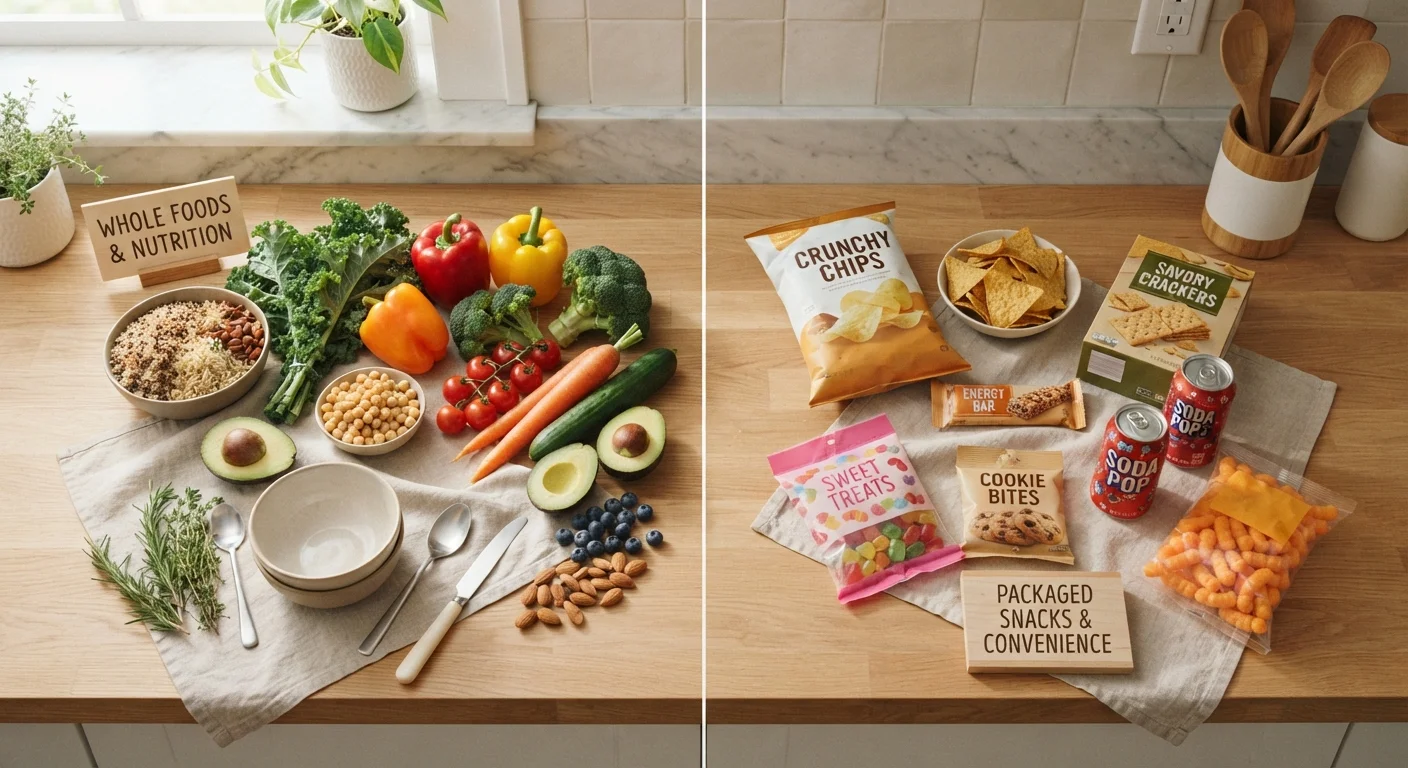
Photo: FeaturingHealth.net | Healthy Living Simplified editorial
Key Takeaways
- Processing exists on a spectrum — canned beans and frozen vegetables are processed but still nutritious choices.
- Ultra-processed foods, not all processed foods, are most consistently linked to poor dietary outcomes.
- Whole foods deliver fiber, micronutrients, and phytochemicals that processing often reduces or removes.
- Practical eating means evaluating individual foods rather than applying a blanket whole-vs-processed rule.
- Reading ingredient lists, not just front-of-pack claims, gives a more reliable picture of a food's quality.
Defining the Terms Honestly
The phrase "whole foods" refers to foods eaten in or close to their natural state — think an apple, a handful of walnuts, a bowl of cooked lentils, or a plain chicken breast. These foods have undergone little to no industrial transformation. Their fiber, vitamins, minerals, and naturally occurring plant compounds (called phytochemicals) remain largely intact.
"Processed foods," by contrast, is a term that covers almost everything else — which is precisely why the label is so often misleading. Cutting and freezing broccoli is processing. Pasteurizing milk is processing. So is adding sugar, artificial flavoring, and emulsifiers to a snack cake. Grouping all of these under one term collapses an enormous range of nutritional outcomes into a single, unhelpful category.
Nutrition researchers increasingly prefer a four-tier classification system called NOVA, developed by researchers at the University of São Paulo. It separates foods into: unprocessed or minimally processed foods, processed culinary ingredients (like oils and flours), processed foods (such as canned fish or cheese), and ultra-processed foods — industrially formulated products designed primarily for palatability and shelf life, often with long ingredient lists featuring additives, flavor enhancers, and refined components. That last category is where the strongest evidence of dietary harm accumulates.
What the Research Actually Shows
When nutrition studies find associations between "processed food" intake and negative health outcomes, they are predominantly capturing the effects of ultra-processed foods — items like sugary beverages, packaged pastries, reconstituted meat products, and flavored chips. These foods tend to be calorie-dense, low in fiber, and high in added sodium and sugar, making it easy to overconsume them while under-delivering on nutritional value.
Whole foods, on the other hand, offer what researchers call a food matrix — a complex physical structure where nutrients interact with each other in ways that isolated supplements simply cannot replicate. Fiber in whole grains slows glucose absorption. Antioxidants in berries work alongside polyphenols in ways that aren't fully understood yet. For more on that distinction, see how whole foods compare to supplements as micronutrient sources.
57%
Share of US calories from ultra-processed foods
A study published in BMJ Open estimated that ultra-processed foods account for roughly 57% of energy intake in the average American diet.
~2x
Fiber intake gap in ultra-processed diets
Research suggests Americans consuming diets high in ultra-processed foods consume approximately half the recommended daily fiber compared to those eating more whole-food-based diets.
None of this means every processed food is nutritionally equivalent to junk food. Canned tomatoes are processed and remain an excellent source of lycopene and vitamin C. Plain Greek yogurt is processed through fermentation and provides protein and probiotics. The question worth asking about any food is not simply "was it processed?" but "what did processing add, and what did it remove?"
How to Apply This in Everyday Eating
Practically speaking, the whole foods vs. processed foods distinction is most useful when it shifts your focus from labels to ingredient lists. Front-of-pack claims like "natural" or "made with whole grains" are largely unregulated and can be misleading — as explained in why healthy labels on food packaging often mean very little. The ingredient list tells you far more.
| Criterion | Whole Foods | Ultra-Processed Foods |
|---|---|---|
| Fiber content | High (naturally intact) | Often low or absent |
| Added sugar | None by definition | Frequently high |
| Sodium | Naturally low | Often elevated |
| Micronutrient retention | High | Reduced; sometimes added back artificially |
| Ingredient list length | One ingredient (the food itself) | Often 15+ items including additives |
| Shelf stability | Limited | Extended via preservatives |
| Food matrix complexity | Intact — nutrients interact naturally | Disrupted by industrial formulation |
A grounded, sustainable approach focuses on building the majority of meals around minimally processed whole foods — vegetables, fruits, legumes, whole grains, nuts, seeds, and minimally processed proteins — while treating ultra-processed items as the exception rather than the foundation. This isn't a rigid prescription; it's a directional framework. A frozen vegetable stir-fry is a reasonable dinner. A diet anchored primarily in packaged, industrially formulated foods leaves consistent nutritional gaps regardless of how the packaging reads.
If cost or access is a barrier, minimally processed options like dried beans, canned fish, frozen produce, and plain rolled oats offer strong nutritional value at lower cost than many whole-food alternatives. Sustainability matters as much as purity when it comes to diet quality over time.
This article is for general informational and educational purposes only and is not a substitute for professional medical or dietary advice. Consult a registered dietitian or qualified healthcare provider for guidance specific to your health needs.
The content on this site is for informational purposes only and is not a substitute for professional advice. Always consult a qualified professional for guidance specific to your situation.