
Supplements vs. Whole Foods as Micronutrient Sources

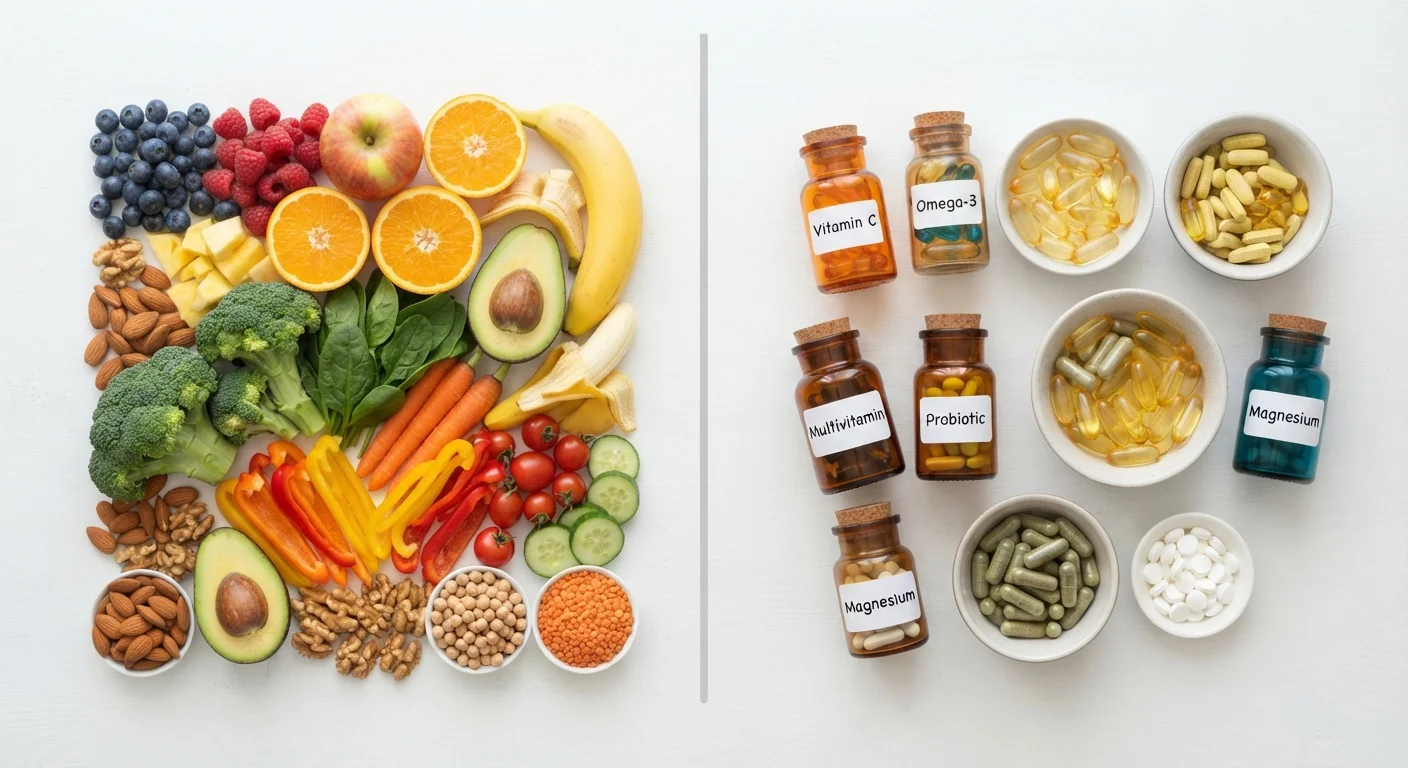
Photo: FeaturingHealth.net | Healthy Living Simplified editorial
Key Takeaways
- Whole foods deliver micronutrients alongside fiber, phytonutrients, and synergistic compounds that supplements cannot replicate.
- Supplements can correct genuine deficiencies but carry risks of excess intake and are not a substitute for a varied diet.
- A food-first approach is the default recommendation from major dietary guidelines, with supplements as a targeted tool.
- Certain populations — including pregnant women, older adults, and those with absorption conditions — may have clinically justified supplement needs.
- Always consult a qualified healthcare provider before starting a supplement regimen.
Deliver nutrients within a complex, synergistic food matrix
Whole foods supply vitamins and minerals alongside fiber, phytonutrients, and other bioactive compounds that work together, often improving absorption and utilization in ways isolated supplements cannot replicate.
Lower risk of consuming excessive nutrient amounts
It is very difficult to reach harmful intake levels of most micronutrients through food alone. The body regulates absorption from food more efficiently than from high-dose supplements.
Support broader health beyond single nutrients
Dietary patterns rich in whole foods are consistently associated in population research with reduced risk of chronic disease — a benefit attributed partly to compounds not captured in any supplement formula.
No need to navigate supplement quality or labeling
Dietary supplements in the U.S. are not required to demonstrate efficacy before sale, and label accuracy varies. Whole foods do not carry the same regulatory uncertainty.
Cannot always correct a clinically confirmed deficiency quickly
Documented deficiencies — such as iron-deficiency anemia or severe vitamin D deficiency — often require supplemental doses that food alone cannot realistically provide in a practical timeframe.
Risk of exceeding safe upper intake levels
High-dose supplements, particularly of fat-soluble vitamins like A and D, can accumulate to toxic levels. Even well-intentioned supplement use can overshoot established tolerable upper intake levels.
Quality and label accuracy vary widely
Third-party testing by organizations such as USP or NSF provides some assurance, but many supplements on the market have not been independently verified for purity or potency.
Nutrient interactions and absorption may differ from food
Some supplemental forms of nutrients are less bioavailable than food forms, and high-dose single nutrients can interfere with the absorption of others — for example, excess zinc can inhibit copper uptake.
What We Mean by Micronutrients — and Why the Source Matters
Micronutrients are the vitamins and minerals your body needs in relatively small amounts to carry out hundreds of essential functions — from energy metabolism and immune signaling to bone maintenance and DNA repair. Unlike macronutrients (carbohydrates, proteins, and fats), which provide calories, micronutrients work as cofactors and regulators. For a grounded overview of what they do, see what vitamins and minerals actually do in the body.
The question of where you get them matters because food and supplements deliver nutrients in fundamentally different contexts. A supplement capsule isolates one or several compounds; a piece of food delivers those same compounds embedded in a complex matrix of fiber, water, fats, proteins, and thousands of additional bioactive substances — many of which influence how the nutrients are absorbed and used.
The Case for Whole Foods as Your Primary Source
Whole foods represent the default recommendation of the USDA Dietary Guidelines and most major nutrition authorities for good reason. They supply nutrients the way human physiology evolved to receive them.
Deliver nutrients within a complex, synergistic food matrix
Whole foods supply vitamins and minerals alongside fiber, phytonutrients, and other bioactive compounds that work together, often improving absorption and utilization in ways isolated supplements cannot replicate.
Lower risk of consuming excessive nutrient amounts
It is very difficult to reach harmful intake levels of most micronutrients through food alone. The body regulates absorption from food more efficiently than from high-dose supplements.
Support broader health beyond single nutrients
Dietary patterns rich in whole foods are consistently associated in population research with reduced risk of chronic disease — a benefit attributed partly to compounds not captured in any supplement formula.
No need to navigate supplement quality or labeling
Dietary supplements in the U.S. are not required to demonstrate efficacy before sale, and label accuracy varies. Whole foods do not carry the same regulatory uncertainty.
One underappreciated dimension is bioavailability — how much of a nutrient actually reaches your cells. The food matrix often enhances absorption. Fat-soluble vitamins (A, D, E, K) absorb far better when consumed with dietary fat; vitamin C in foods improves iron absorption from plant sources. Supplements can replicate the nutrient but not always the synergistic environment. For more on how food pairings affect absorption, see how what you eat together affects nutrient absorption.
Whole foods also provide dietary fiber and phytonutrients — plant compounds like flavonoids and carotenoids — that are largely absent from standard supplement formulas and are associated with long-term health benefits in observational research.
Where Supplements Have a Legitimate Role
Despite the food-first principle, there are real situations where whole foods alone may not close the gap. Supplements are a clinically and practically justified tool in specific circumstances.
Cannot always correct a clinically confirmed deficiency quickly
Documented deficiencies — such as iron-deficiency anemia or severe vitamin D deficiency — often require supplemental doses that food alone cannot realistically provide in a practical timeframe.
Risk of exceeding safe upper intake levels
High-dose supplements, particularly of fat-soluble vitamins like A and D, can accumulate to toxic levels. Even well-intentioned supplement use can overshoot established tolerable upper intake levels.
Quality and label accuracy vary widely
Third-party testing by organizations such as USP or NSF provides some assurance, but many supplements on the market have not been independently verified for purity or potency.
Nutrient interactions and absorption may differ from food
Some supplemental forms of nutrients are less bioavailable than food forms, and high-dose single nutrients can interfere with the absorption of others — for example, excess zinc can inhibit copper uptake.
Beyond individual health conditions, certain nutrients are genuinely difficult to obtain in adequate amounts from diet alone for large segments of the population. Vitamin D — produced primarily through sun exposure — is one example; vitamin B12 is another for people following fully plant-based diets. For a practical breakdown of which nutrients are hardest to source through food, consult the everyday eater's reference to essential micronutrients.
Special Populations and Supplement Needs
It is also worth recognizing that eating patterns, cooking methods, medications, and gut health can all reduce how much you absorb even from a well-chosen diet. Factors that quietly deplete micronutrients are often overlooked when evaluating whether supplementation is warranted.
Making a Practical Decision for Your Own Diet
Before reaching for a supplement, a realistic self-assessment of your eating patterns is a useful first step. Are there entire food groups you consistently avoid? Do you eat fewer than two to three servings of vegetables daily? Tools like a dietary self-assessment for micronutrient gaps can help you spot weak spots worth addressing through food choices first.
~93%
Americans falling short of vitamin D from diet
USDA dietary intake data consistently shows vitamin D among the most under-consumed nutrients in the American diet, making it one of the more commonly justified supplementation cases.
~40%
U.S. adults who take a daily multivitamin
According to CDC and NIH survey data, multivitamins are the most commonly used dietary supplement in the United States, though evidence for broad benefit in well-nourished adults remains limited.
If you do determine that a supplement may be appropriate, a few principles apply. Higher doses are not automatically better — fat-soluble vitamins accumulate in tissue and can reach toxic levels; even water-soluble vitamins like B6 can cause harm at very high supplemental doses over time. Choose single-nutrient supplements over broad multivitamins when targeting a specific shortfall, and involve a healthcare provider in that decision.
For readers new to thinking about the broader nutritional picture, understanding macronutrients as a starting point provides useful foundational context alongside the micronutrient lens discussed here.
This article is for general informational and educational purposes only and does not constitute medical advice. Talk to a qualified healthcare professional before making changes to your diet or starting any supplement.
The content on this site is for informational purposes only and is not a substitute for professional advice. Always consult a qualified professional for guidance specific to your situation.