
Behaviour Substitution vs. Habit Elimination: Understanding the Difference

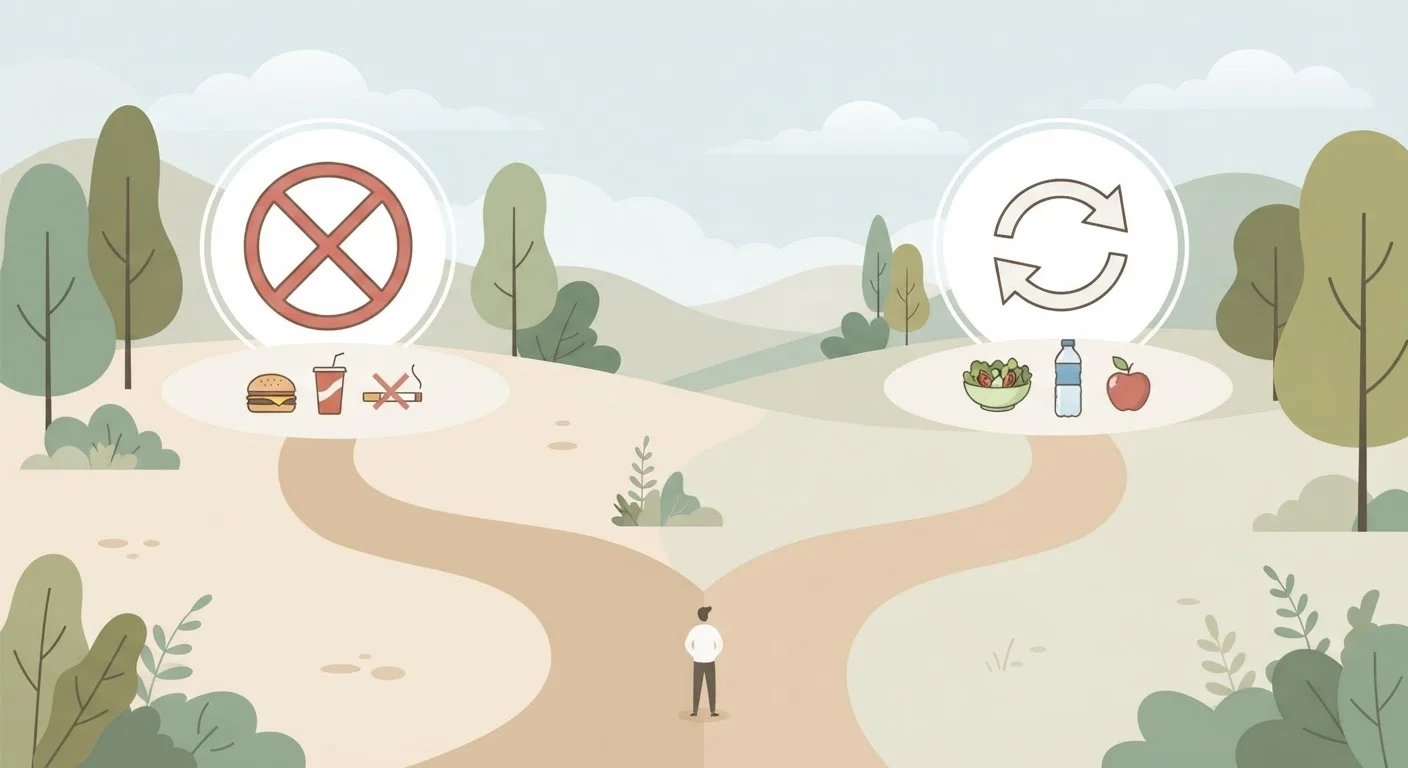
Photo: FeaturingHealth.net | Healthy Living Simplified editorial
Key Takeaways
- Behaviour substitution replaces a harmful habit with a healthier one that satisfies the same underlying need.
- Habit elimination aims to remove a behaviour entirely, without a direct replacement.
- Research suggests substitution is often more durable because it works with the brain's existing reward pathways.
- Neither strategy works universally — the best approach depends on the habit's function and the individual's context.
- Combining environmental redesign with either strategy significantly improves success rates.
What Each Strategy Actually Means
When people decide to change a bad habit, they typically imagine one of two outcomes: stopping the behaviour cold or swapping it for something better. These represent two genuinely distinct strategies — habit elimination and behaviour substitution — and conflating them leads to mismatched expectations and failed attempts.
Habit elimination is the goal of removing a behaviour from your repertoire entirely. No replacement is introduced; the aim is simply cessation. Think of someone deciding to stop checking social media before bed — full stop, no alternative activity planned.
Behaviour substitution, by contrast, keeps the structure of the habit intact but swaps the routine itself. The cue that triggers the habit and the reward it delivers remain the same; only the middle step changes. Someone who stress-eats might instead go for a short walk when tension spikes — same trigger, different response, similar sense of relief.
Understanding why the habit loop forms in the first place is foundational here: habits persist because the brain has encoded a reliable cue-routine-reward sequence. Any change strategy that ignores the reward component faces an uphill battle.
The Evidence Behind Each Approach
Research in behavioural psychology consistently shows that attempts to simply suppress or eliminate a well-ingrained behaviour are harder to sustain than strategies that redirect it. A frequently cited reason is that suppression demands ongoing cognitive effort — the moment willpower lapses, the original behaviour resurfaces.
~66 days
Average time for a new habit to become automatic
A 2010 study published in the European Journal of Social Psychology (Lally et al.) found habit automaticity formed over a range of 18 to 254 days, with a mean around 66 days.
~40%
Daily behaviours performed out of habit
Research by Wendy Wood and colleagues estimates that roughly 40 percent of daily actions are habitual rather than consciously decided, underscoring the scale of automatic behaviour.
Substitution leverages what neuroscientists call synaptic competition: the new routine gradually strengthens its neural pathway while the old one weakens through disuse. Studies on habit formation suggest that the reward signal — not the behaviour itself — is what the brain is most reluctant to give up. Preserving that reward while changing the action is, for many people, more neurologically efficient.
Elimination, however, has real-world applications. For habits where any engagement primes further craving — certain substance-use patterns being the clearest example — substitution can sometimes maintain a reinforcing cycle rather than break it. In those cases, complete removal, ideally alongside professional support, may be the more appropriate route. The cold turkey versus gradual reduction debate explores these tradeoffs in greater depth.
Substitution Is Not Always Safe for Every Habit
Comparing the Two Strategies Head-to-Head
Both approaches have distinct strengths and genuine limitations. The table below maps out how they differ across the criteria that matter most for everyday habit change.
| Behaviour Substitution | Habit Elimination | |
|---|---|---|
| Core mechanism | Replaces the routine, preserves the reward | Removes the behaviour entirely |
| Works best when | Habit fulfils a clear psychological need | Habit has no healthy version or any use reinforces it |
| Cognitive demand | Moderate — redirecting, not suppressing | High — requires ongoing suppression |
| Long-term sustainability | Generally higher for most lifestyle habits | Lower unless supported by strong motivation or structure |
| Risk of relapse | Lower if substitute meets the same need | Higher without environmental or social support |
| Best supported by | Identifying the underlying cue and reward | Environmental changes and professional support |
Notice that neither strategy wins across every dimension. Substitution tends to score higher on sustainability and ease of adoption; elimination scores higher for situations where behavioural contagion — where even small exposures re-activate the habit — is a real concern.
For most general health habits, redesigning your environment amplifies whichever strategy you choose by reducing the friction that triggers the old behaviour in the first place.
Choosing the Right Strategy for Your Situation
A useful starting question is: What need does this habit serve? If you can identify a clear function — managing stress, relieving boredom, providing social connection — substitution is usually the more practical path, because you're not asking your brain to abandon a reward, only to find it differently.
Map the Habit Before Choosing a Strategy
If the habit genuinely has no identifiable reward, or if the behaviour is harmful enough that any version of it is problematic, elimination becomes more appropriate. Even then, filling the time and mental space the habit occupied — with structured activity, social engagement, or a new routine — tends to produce better outcomes than leaving a vacuum.
It's also worth considering your broader approach to behaviour change. If you're drawn to incremental methods, see how tiny habits compare to bigger behavioural overhauls. If you're unsure which change framework suits your mindset, identity-based versus outcome-based habit formation offers another useful lens. And if past attempts haven't stuck, it's worth reading about why habit change attempts sometimes backfire before trying again.
This article is for general informational and educational purposes only and is not a substitute for professional medical or mental health advice. If you are struggling with a habit that significantly affects your health or wellbeing, please consult a qualified healthcare professional.
The content on this site is for informational purposes only and is not a substitute for professional advice. Always consult a qualified professional for guidance specific to your situation.