
Tiny Habits vs. Big Leaps: Which Approach to Behavior Change Works Better?

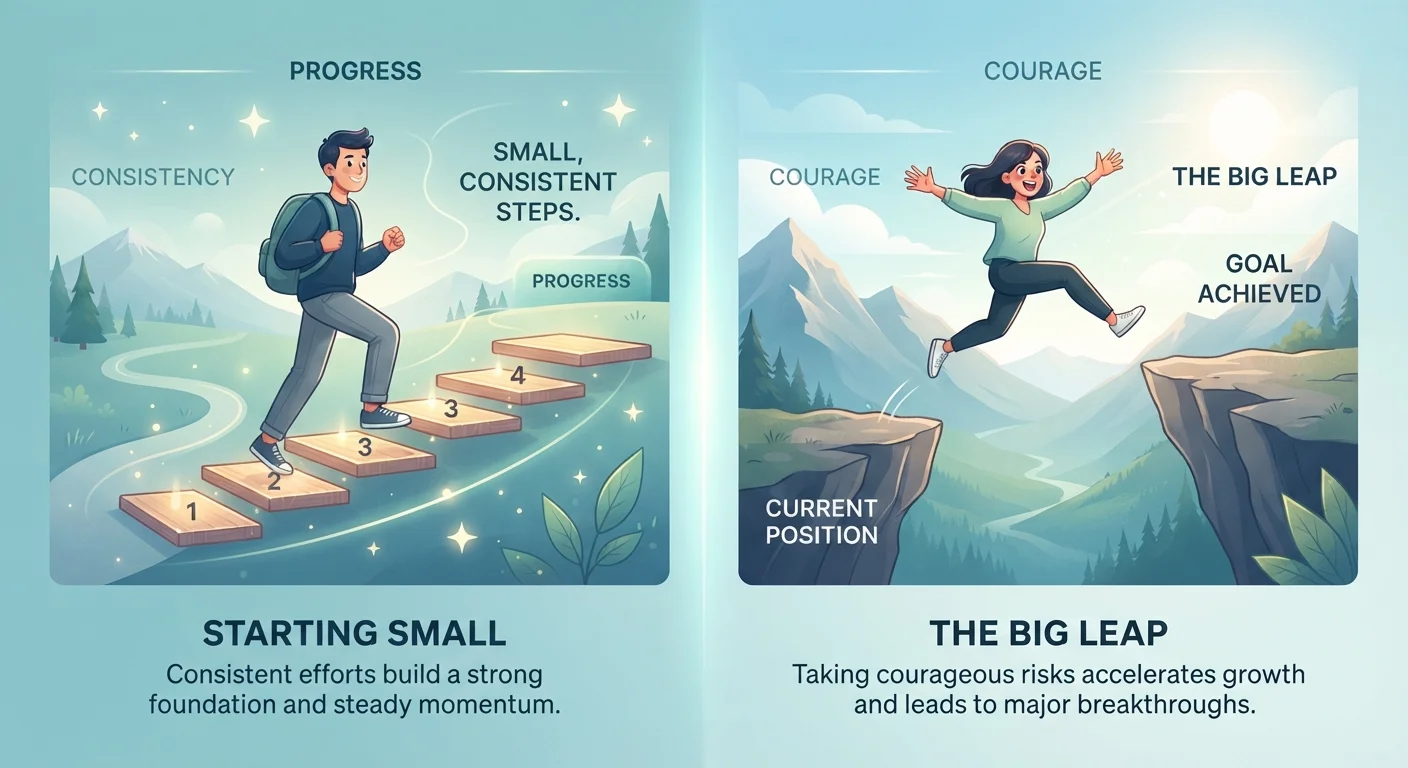
Photo: FeaturingHealth.net | Healthy Living Simplified editorial
Key Takeaways
- Tiny habits leverage neurological automaticity, making new behaviors easier to sustain over time.
- Big-leap approaches can accelerate change but carry higher dropout risk without strong support structures.
- Research suggests the best strategy often depends on individual motivation levels and life circumstances.
- Combining both approaches — starting small and scaling up — may offer the most durable outcomes.
- Consistency over time, not initial intensity, is the strongest predictor of lasting behavior change.
What the Science Says About Behavior Change
Behavioral scientists have spent decades studying how humans adopt and maintain new habits. Two broad philosophies have emerged from this research: incremental change (often called tiny habits) and rapid overhaul (commonly described as big leaps or immersive change).
Dr. BJ Fogg's work at Stanford University on habit formation suggests that shrinking behaviors to their smallest viable form reduces the motivation threshold required to act. When a behavior is tiny enough, it bypasses the resistance that derails most change efforts. On the other side, research on motivational spikes — such as studies examining behavior change following health scares or major life transitions — indicates that high-arousal moments can briefly unlock dramatic shifts in routine.
Neither camp is universally right. What the evidence does consistently show is that automaticity — the point at which a behavior runs without conscious effort — is the true marker of a habit. And automaticity is built through repetition over time, regardless of how dramatically you begin. For more on how small actions accumulate into lasting protection, see how preventive habits compound over decades.
The Case for Tiny Habits
The tiny habits model works by anchoring a miniature version of a desired behavior to an existing routine — a technique called habit stacking. Instead of committing to a 30-minute workout, you start with two minutes of movement after your morning coffee. The goal is not the action itself but the neural pathway it begins to carve.
Start Smaller Than Feels Necessary
Psychologically, small wins trigger the brain's reward system. Each completed micro-habit releases a modest dose of dopamine, which reinforces the loop of cue → behavior → reward. Over time, that loop strengthens without requiring ongoing willpower expenditure. This is especially important because willpower is a limited cognitive resource that depletes with use — a concept supported by self-regulation research.
Tiny habits also survive disruption better. When illness, travel, or stress interrupts a grand plan, a two-minute habit is far easier to resume than an hour-long regimen. Habit stacking is a particularly effective method for making this approach automatic with minimal effort.
66 days
Average time for a habit to become automatic
A 2010 study published in the European Journal of Social Psychology found habit formation took 18 to 254 days, with 66 days as the average across participants.
~40%
Daily behaviors estimated to be habitual
Research by Duke University psychologist David Neal and colleagues suggests roughly 40 percent of daily actions are performed out of habit rather than deliberate decision-making.
The Case for Big Leaps
Big-leap approaches — committing to a significant behavioral overhaul at once — are not without merit. Research on implementation intentions shows that specific, ambitious plans can produce meaningful short-term results, particularly when a person's motivation is genuinely high.
Moments of heightened readiness, such as New Year's resolutions, post-diagnosis decisions, or major life changes, create what psychologists call a fresh start effect. People feel psychologically distanced from their past behavior and more open to identity-level shifts. Studies published in journals including Psychological Science have documented these motivational windows as real and potentially useful.
The limitation is sustainability. Without environmental redesign and social support, the motivation fueling a big leap tends to erode within weeks. Redesigning your environment is one of the most evidence-backed ways to extend the life of an ambitious commitment by reducing the friction that leads to backsliding.
Head-to-Head: Comparing Both Approaches
To make a practical decision, it helps to see how each approach performs across key dimensions that affect real-world success.
| Tiny Habits | Big Leaps | |
|---|---|---|
| Initial effort required | Very low — designed to feel easy | High — demands strong motivation upfront |
| Speed of visible results | Slow and gradual | Faster early progress possible |
| Sustainability over time | High — automaticity builds steadily | Lower without strong support systems |
| Resilience to disruption | High — easy to restart after a slip | Low — momentum breaks easily |
| Willpower demand | Minimal after initial setup | Heavy, especially in early weeks |
| Best motivational window | Everyday baseline motivation | High-arousal fresh-start moments |
| Risk of burnout | Low | Moderate to high |
As the comparison illustrates, neither approach dominates across every category. Your circumstances, personality, and available support structures all influence which will serve you better. For a deeper look at how motivation type affects habit durability, see intrinsic vs. extrinsic rewards in habit building.
When to Combine Both Strategies
The most effective approach for many people may be a hybrid: using a motivational surge to commit to a direction, then immediately engineering tiny, repeatable actions to carry that commitment forward. Think of the big leap as the spark and tiny habits as the fuel system.
For example, a meaningful health scare might prompt someone to overhaul their diet. Rather than overhauling everything at once, they could commit to one daily action — adding a vegetable to one meal — and build systematically from there. This mirrors guidance within healthy eating habits resources, where gradual dietary shifts tend to outlast restrictive overhauls.
It's also worth understanding how slips fit into either model. Setbacks are not evidence that a strategy failed — they are a normal part of behavior change. What research says about relapses can help reframe a stumble as data rather than defeat, keeping you on track regardless of which approach you chose.
This article is for informational purposes only and does not constitute medical advice. Consult a qualified healthcare professional before making significant changes to your health behaviors, particularly if you have an existing medical condition.
The content on this site is for informational purposes only and is not a substitute for professional advice. Always consult a qualified professional for guidance specific to your situation.