
Intrinsic vs. Extrinsic Rewards in Habit Building

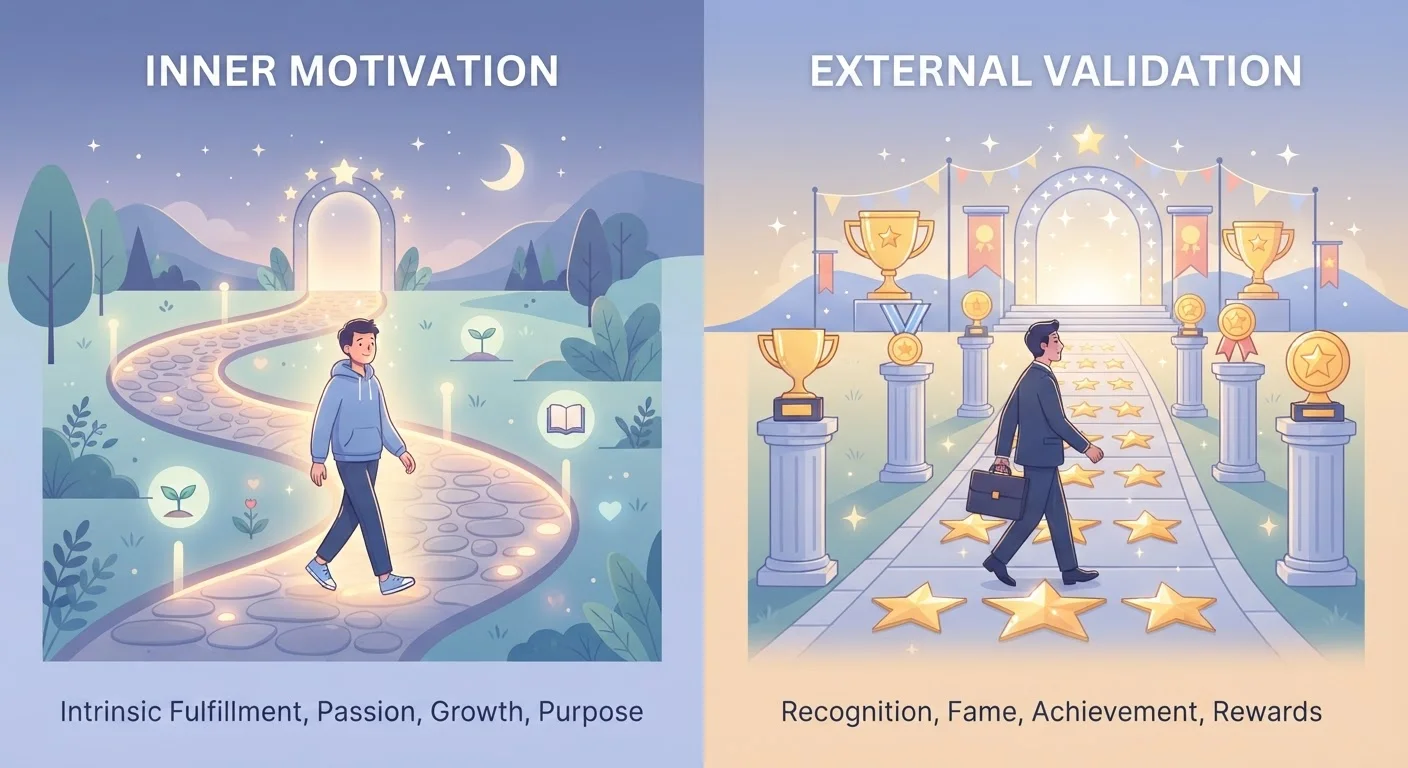
Photo: FeaturingHealth.net | Healthy Living Simplified editorial
Key Takeaways
- Intrinsic rewards come from within — enjoyment, mastery, and personal meaning — and tend to sustain habits long-term.
- Extrinsic rewards are external incentives like points, praise, or prizes that can jump-start new behaviors effectively.
- Over-relying on extrinsic rewards can reduce intrinsic motivation — a phenomenon researchers call the 'overjustification effect.'
- The most durable habits typically begin with external support and gradually shift toward internal motivation.
- Designing habits around personal values accelerates the transition from external reward to intrinsic drive.
What Makes a Reward Intrinsic or Extrinsic?
At its core, the distinction is about origin. An intrinsic reward lives inside the activity itself — the calm you feel after a morning walk, the satisfaction of finishing a healthy meal you prepared yourself, or the sense of competence that builds as you get stronger. These experiences are self-generated and do not require any outside validation.
An extrinsic reward, by contrast, comes from an external source — a fitness app badge, a friend's compliment, a prize for meeting a goal, or even money. These incentives exist separately from the behavior and are contingent on performing it.
Understanding this distinction matters enormously for habit formation. As researchers in self-determination theory have consistently found, behaviors driven by intrinsic motivation are more likely to persist, even without external pressure or reward. To understand how rewards fit into the broader habit architecture, see how the habit loop works.
| Criterion | Intrinsic Rewards | Extrinsic Rewards |
|---|---|---|
| Source | Internal (enjoyment, meaning, mastery) | External (praise, prizes, points) |
| Best phase of habit | Maintenance and long-term consistency | Initiation and early momentum |
| Durability without reward | High — behavior continues independently | Low — may stop when incentive ends |
| Risk of backfire | Low | Moderate (overjustification effect) |
| Requires external system | No | Yes (tracker, accountability, prizes) |
| Connection to identity | Strong — tied to values and self-concept | Weak — tied to outcome, not identity |
The Overjustification Effect: When External Rewards Backfire
One of the most important findings in motivational psychology is the overjustification effect — the counterintuitive phenomenon where adding an extrinsic reward to an already-enjoyable activity can actually reduce a person's intrinsic interest in it. Classic research by Deci, Koestner, and Ryan (published across multiple studies and summarized in their 1999 meta-analysis in Psychological Bulletin) found that tangible, expected rewards consistently undermined intrinsic motivation for activities people already found engaging.
In practical terms: if you genuinely enjoy evening stretching, introducing a points system to "earn" it may gradually shift your mental framing from "I do this because it feels good" to "I do this for the reward" — and when the reward disappears, so does the behavior.
A Note on Verbal Praise
This doesn't mean extrinsic rewards are harmful across the board. When a habit feels tedious or unfamiliar, external incentives provide necessary early support. The risk arises specifically when rewards are applied to activities that are already intrinsically motivating.
Using Extrinsic Rewards as a Launching Pad
Extrinsic rewards are most valuable during the initiation phase of a new habit — the period when the behavior is effortful, unfamiliar, and not yet automatic. Using a habit tracker, sharing progress with a friend, or setting milestone-based incentives can provide the external scaffold that keeps you consistent while neural pathways strengthen.
The strategic goal, however, is to treat extrinsic rewards as temporary. Research on habit formation suggests it takes weeks to months for a new behavior to become automatic, depending on complexity. During that window, external motivation buys time for intrinsic motivation to develop. For a practical framework on designing this transition, the habit design checklist offers evidence-informed guidance.
Gradual fading of external rewards — rather than abrupt removal — tends to preserve the intrinsic motivation that has begun to form underneath.
59%
Drop in intrinsic motivation after expected rewards
A 1999 meta-analysis in Psychological Bulletin by Deci, Koestner, and Ryan found expected, tangible rewards significantly undermined intrinsic motivation across 128 studies.
66 days
Average time for a new habit to become automatic
A study published in the European Journal of Social Psychology (Lally et al., 2010) found habit automaticity developed over an average of 66 days, ranging widely by behavior complexity.
Cultivating Intrinsic Motivation Deliberately
Intrinsic motivation doesn't just happen — you can actively design for it. Three psychological needs, identified by self-determination theory, predict whether intrinsic motivation will emerge:
- Autonomy: Choosing the habit yourself, or shaping how you practice it, reinforces ownership. Even small choices — which route you walk, what healthy breakfast you prepare — strengthen the sense that the habit is genuinely yours.
- Competence: Noticing improvement builds intrinsic reward. Keeping a simple log of progress draws attention to growth, making the activity more internally satisfying over time.
- Relatedness: Connecting a habit to something that matters — your health, your values, your sense of self — deepens meaning. This is closely tied to identity-based habit formation, where the goal is to see the behavior as an expression of who you are, not just what you want to achieve.
If you're building from the ground up, the step-by-step habit walkthrough applies these principles in sequence.
This article is for informational purposes only and does not constitute medical or psychological advice. For personalized guidance on behavior change, consult a qualified healthcare or mental health professional.
The content on this site is for informational purposes only and is not a substitute for professional advice. Always consult a qualified professional for guidance specific to your situation.