
The Habit Loop: How Cue, Routine, and Reward Shape Your Daily Behavior

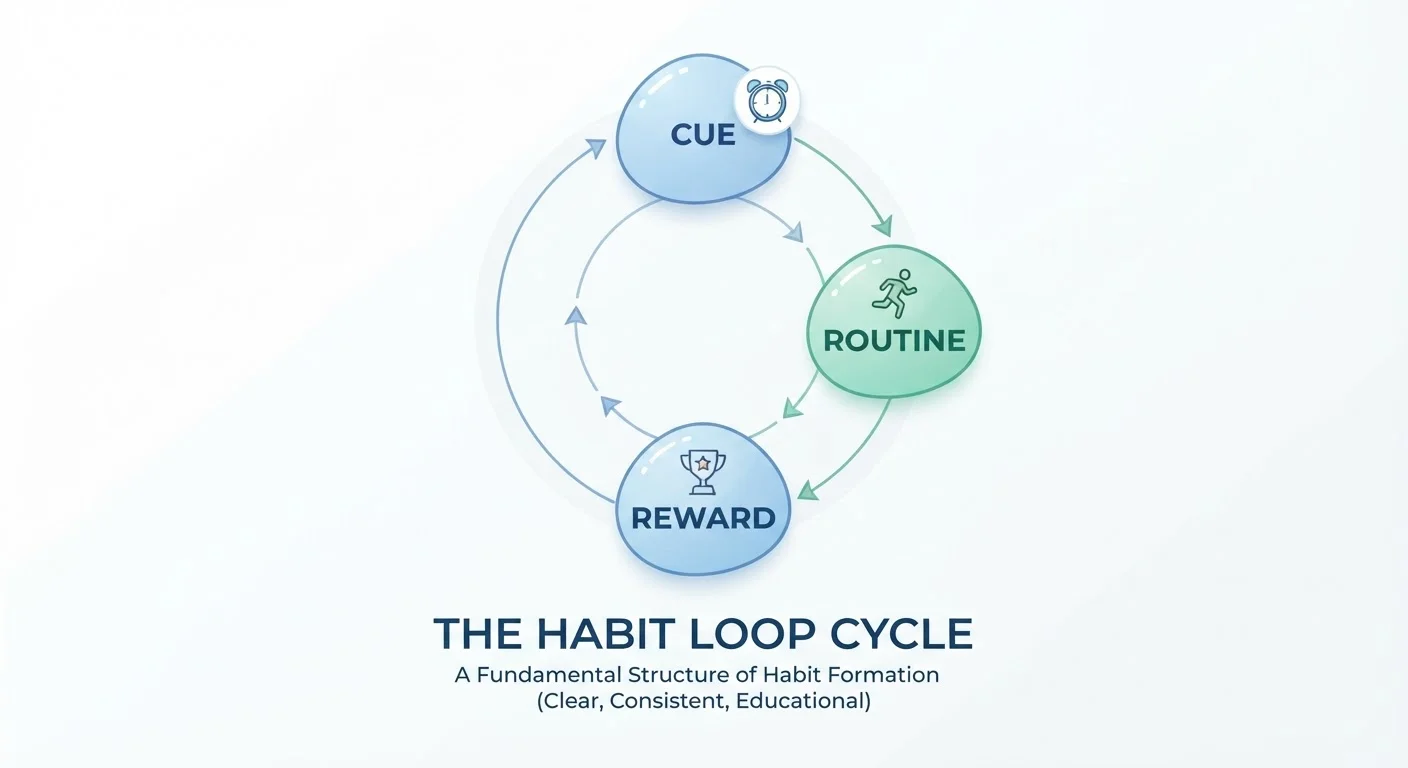
Photo: FeaturingHealth.net | Healthy Living Simplified editorial
Key Takeaways
- Every habit is driven by a three-part loop: cue, routine, and reward.
- Cues can be times of day, locations, emotions, people, or preceding actions.
- The reward must feel satisfying immediately to reinforce the routine effectively.
- You can build new habits by deliberately engineering all three loop components.
- Changing an existing habit is easier when you keep the cue and reward but swap the routine.
- Awareness of your own habit loops is the first step toward any lasting behavior change.
What the Habit Loop Actually Is
Every habit you have — brushing your teeth, reaching for your phone, going for a morning walk — follows the same underlying structure. MIT neuroscientists studying the basal ganglia in the 1990s discovered that the brain chunks repeated behaviors into a single automatic sequence, reducing cognitive load. The result is the habit loop: cue → routine → reward.
The cue is a trigger that tells your brain to initiate a specific behavior. The routine is the behavior itself — physical, mental, or emotional. The reward is the positive outcome that signals to your brain that this loop is worth remembering and repeating. Over time, the loop becomes so encoded that the cue alone generates a craving for the reward, which is what makes habits feel automatic and, sometimes, compulsive.
For a deeper look at the behavioral science underlying this process, see what behavioral science tells us about forming lasting habits.
The Loop Is Neurological, Not Moral
Breaking Down Each Component
Cues: The Starting Gun
Cues fall into five broad categories: time of day, location, emotional state, other people, and a preceding action. Your alarm going off (time) might cue a morning jog. Sitting at your desk (location) might cue a coffee reach. Feeling stressed (emotion) might cue a snack. Identifying which category your cue falls into is the first step to gaining control over any habit.
Routines: The Behavior Itself
Routines are the most visible part of the loop — the action you actually take. What makes routines powerful is that once a loop is established, very little deliberate thought is required to execute them. This is why structured daily routines make healthy choices easier: when the cue reliably triggers the routine, willpower becomes largely irrelevant.
Rewards: What the Brain Is Really After
The reward teaches your brain whether a particular loop is worth encoding. Importantly, the reward must be felt immediately after the routine — delayed gratification does not reinforce behavior the same way. Effective rewards include a burst of physical energy, a sense of calm, social connection, or even a brief moment of pride. Over repeated cycles, the brain begins to anticipate the reward the moment a cue appears, generating a craving that sustains the habit.
Using the Loop to Build Healthier Habits
Understanding the loop gives you a practical design tool. Instead of relying on motivation — which is inherently unreliable — you engineer the three components deliberately. Choose a clear, consistent cue that already exists in your day. Attach a simple, specific routine to it. Then plan a genuine reward that you will actually experience right after completing the behavior.
This approach works because you are working with the brain's existing architecture rather than against it. Research on implementation intentions shows that specifying when, where, and how you will perform a behavior significantly increases follow-through. Pairing that specificity with a meaningful reward closes the loop and accelerates automaticity.
Start With the Smallest Viable Routine
For habits you want to change rather than build from scratch, the most evidence-supported strategy is routine substitution: keep the cue and reward intact, but insert a healthier routine between them. This works because the underlying craving — triggered by the cue — is still being satisfied. Explore this further in our guide on why bad habits are so hard to break.
It is also worth recognizing that your environment and social surroundings quietly shape your cues. The people in your life often act as unintentional cues for both helpful and unhelpful behaviors — something explored in depth in our piece on how social circles shape what we repeat.
66 days
Average time for a new habit to become automatic
A study published in the European Journal of Social Psychology (Lally et al., 2010) found automaticity developed over an average of 66 days, ranging from 18 to 254 days depending on the behavior and individual.
40–45%
Share of daily actions driven by habits, not decisions
Research by Wendy Wood and colleagues at Duke University estimated that roughly 40–45% of everyday behaviors are habitual rather than consciously decided in the moment.
2–3x
Higher follow-through with implementation intentions
Meta-analyses of implementation intention research (Gollwitzer & Sheeran, 2006) found that specifying when, where, and how to perform a behavior roughly doubled or tripled follow-through rates compared to goal-setting alone.
This article is for informational purposes only and is not medical advice. For personal health concerns, consult a qualified healthcare professional.
Frequently Asked Questions
The content on this site is for informational purposes only and is not a substitute for professional advice. Always consult a qualified professional for guidance specific to your situation.