
What Behavioral Science Actually Tells Us About Forming Lasting Habits

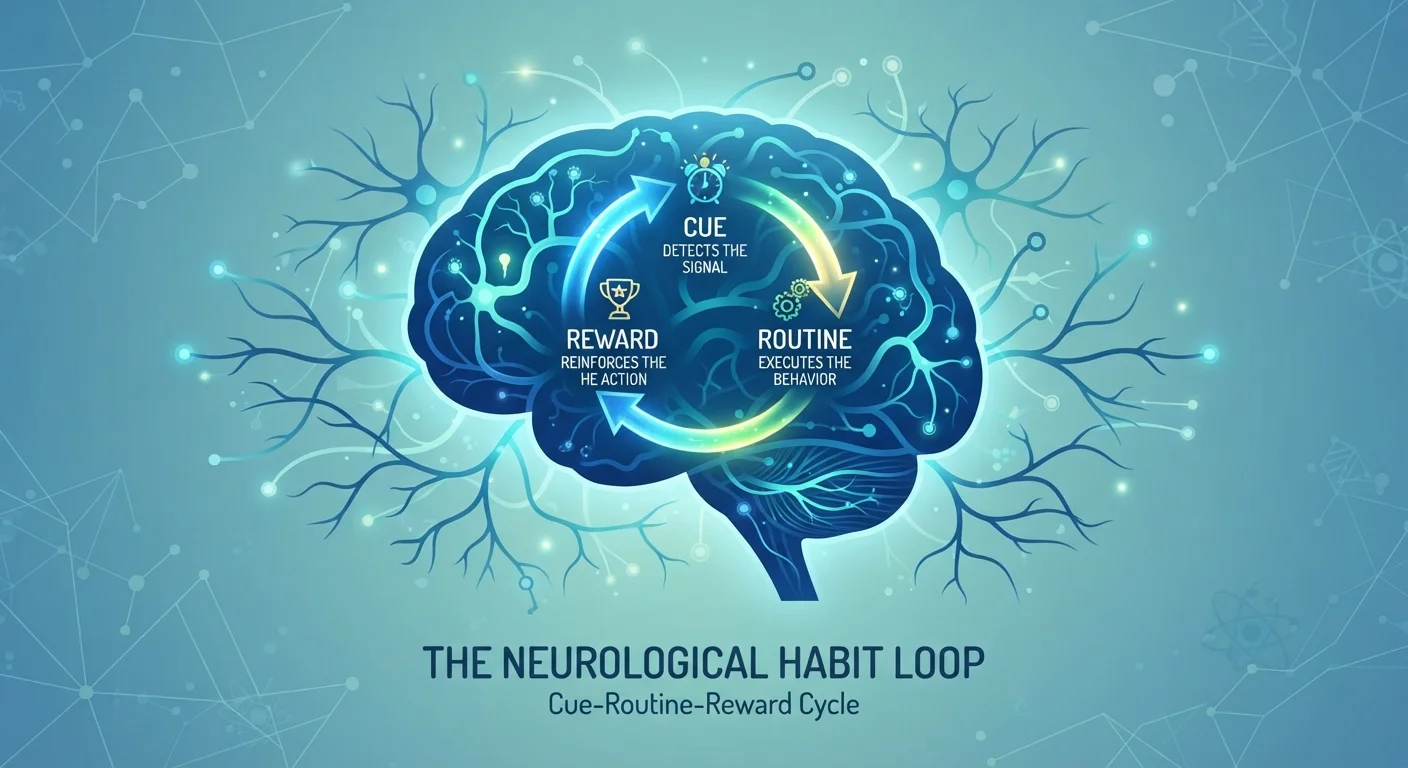
Photo: FeaturingHealth.net | Healthy Living Simplified editorial
Key Takeaways
- Habits form through a cue-routine-reward loop that gradually becomes automatic with repetition.
- Implementation intentions — specific if-then plans — significantly increase follow-through on new behaviors.
- Environmental design reduces decision fatigue and makes healthy defaults easier to choose.
- Consistency over time, not motivational intensity, is the primary driver of lasting habit change.
- Variable reward schedules can sustain engagement, but intrinsic motivation supports longer-term adherence.
The Core Architecture of a Habit
Habits are not random. Neuroscientists and behavioral psychologists have identified a consistent three-part structure underlying nearly every habitual behavior: a cue that triggers the behavior, a routine that constitutes the behavior itself, and a reward that reinforces it. This loop — sometimes called the habit loop — is described in detail in The Science Behind Habit Formation and Daily Structure.
What makes this loop powerful is repetition. Each time the cue-routine-reward sequence fires, the neural pathway associated with that behavior becomes marginally more automatic. Over time, the brain's basal ganglia — a region associated with procedural learning — encodes the sequence so efficiently that the behavior can run with minimal conscious input. This is why experienced drivers can navigate familiar routes while holding a conversation.
Understanding this architecture is the starting point for intentional habit design. You can engineer the cue, shape the routine, and choose the reward — rather than waiting for behavior to emerge by chance.
Operant Conditioning: How Rewards Wire Behavior
Behavioral psychologist B.F. Skinner's work on operant conditioning established that behaviors followed by positive outcomes are more likely to be repeated. This principle — while over a century old — remains central to how habits are built and sustained.
In practical terms, reinforcement doesn't need to be elaborate. It can be as simple as checking a box on a habit tracker, a brief moment of self-acknowledgment, or the intrinsic satisfaction of completing a task. What matters is that the reward follows the behavior closely in time.
43%
Of daily behaviors are habitual
A study by Wood, Quinn, and Kashy (2002) estimated that roughly 43% of everyday behaviors are performed habitually in the same context each day.
66 days
Median time to habit automaticity
Lally et al. (2010) found the median time for a new behavior to become automatic was approximately 66 days across a variety of health behaviors.
2–3x
Higher follow-through with if-then plans
Meta-analyses of implementation intention research indicate that forming specific if-then plans can more than double the likelihood of acting on an intention.
Importantly, research on variable reward schedules — where rewards are unpredictable rather than fixed — shows they can sustain behavior longer than consistent rewards, partly because unpredictability maintains engagement. This is one reason some digital apps retain users effectively, though the same mechanism can work in healthy habit contexts. For a full breakdown of these terms, see the Key Terms in Habit Science glossary.
Implementation Intentions: The If-Then Formula
One of the most robust findings in habit research is that vague intentions — "I'll exercise more" — rarely translate into consistent behavior. What does work is a technique called an implementation intention: a specific plan that takes the form "If , then I will ."
Psychologist Peter Gollwitzer, who formalized this concept, has shown across numerous studies that people who form if-then plans are significantly more likely to follow through than those who rely on general intentions alone. The mechanism is straightforward: by pre-deciding the response to a specific cue, you reduce the cognitive load at the moment of action.
Attach your new habit to a reliable daily anchor — like brewing coffee or brushing teeth — rather than a vague intention like 'morning.' Specificity eliminates the gap between intention and action.
Make the reward immediate and clearly connected to the behavior itself. If the benefit is weeks away, your brain won't associate it with today's effort.
Examples of effective implementation intentions:
- "If it is 7:00 a.m. and I've finished breakfast, then I will take a 10-minute walk."
- "If I feel the urge to reach for my phone during work, then I will take three slow breaths instead."
The specificity of time, place, and trigger is what gives these plans their power.
Habit Stacking and Environmental Design
Habit stacking is a practical application of implementation intentions. Rather than creating a new cue from scratch, you anchor a new behavior to an existing, reliable one. The formula: "After I , I will ." Because the existing habit already fires reliably, it becomes a built-in trigger for the new behavior.
Start Smaller Than Feels Necessary
Equally important is environmental design — structuring your physical surroundings to make desired behaviors easier and unwanted behaviors harder. Behavioral economists call this choice architecture. Placing a water bottle on your desk, keeping workout clothes visible, or removing junk food from your direct line of sight are all low-effort design interventions that research supports as effective nudges toward healthier defaults.
Don't Rely on Willpower Alone
For those working to dismantle unhealthy patterns alongside building new ones, the Evidence-Based Roadmap for Breaking Bad Habits offers a complementary framework rooted in the same behavioral science principles.
Why Consistency Beats Motivation
Motivation is an unreliable driver of behavior change. It fluctuates with mood, energy, stress, and circumstance. Behavioral science consistently shows that the durability of a habit depends far more on consistency of repetition in a stable context than on the intensity of the initial intention.
How Long Does Habit Formation Actually Take?
This is also why behavioral researchers recommend focusing on process goals ("I will walk every morning") over outcome goals ("I will lose weight"), at least in the early stages of habit formation. Process goals create the repetition needed for automaticity; outcomes are a byproduct that follows over time.
Neuroscience research on why habits resist change also helps explain the flip side: once a behavior becomes automatic, it is genuinely difficult to dislodge — which is why building the right habits from the start is more efficient than trying to replace ingrained ones later.
“The most effective way to change your habits is to focus not on what you want to achieve, but on who you wish to become. Every action you take is a vote for the type of person you wish to be.”
— James Clear, Behavioral science author and habit researcher
Putting It All Together
Behavioral science doesn't offer a single magic formula — it offers a toolkit. The most effective habit-formation strategies combine several principles simultaneously:
- Define your cue clearly — a specific time, place, or preceding behavior.
- Design the routine to be as frictionless as possible at the outset.
- Choose a reward that follows the behavior promptly and feels genuinely satisfying.
- Write an implementation intention that pre-commits you to the behavior in that specific context.
- Adjust your environment so the default choice is the healthy one.
- Repeat consistently — not perfectly, but reliably enough for automaticity to develop.
Missing a single instance rarely derails a habit; research by Lally et al. found that occasional lapses had little impact on long-term habit formation. What matters is returning to the routine promptly. For readers exploring the broader landscape of breaking unhealthy patterns or building preventive daily habits, these behavioral principles serve as the shared foundation.
This Is General Information, Not Medical Advice
This article is for general informational and educational purposes only and does not constitute medical or psychological advice. Always consult a qualified healthcare professional for guidance tailored to your personal health circumstances.
The content on this site is for informational purposes only and is not a substitute for professional advice. Always consult a qualified professional for guidance specific to your situation.