
The Habit Loop: Why Bad Habits Are So Hard to Break

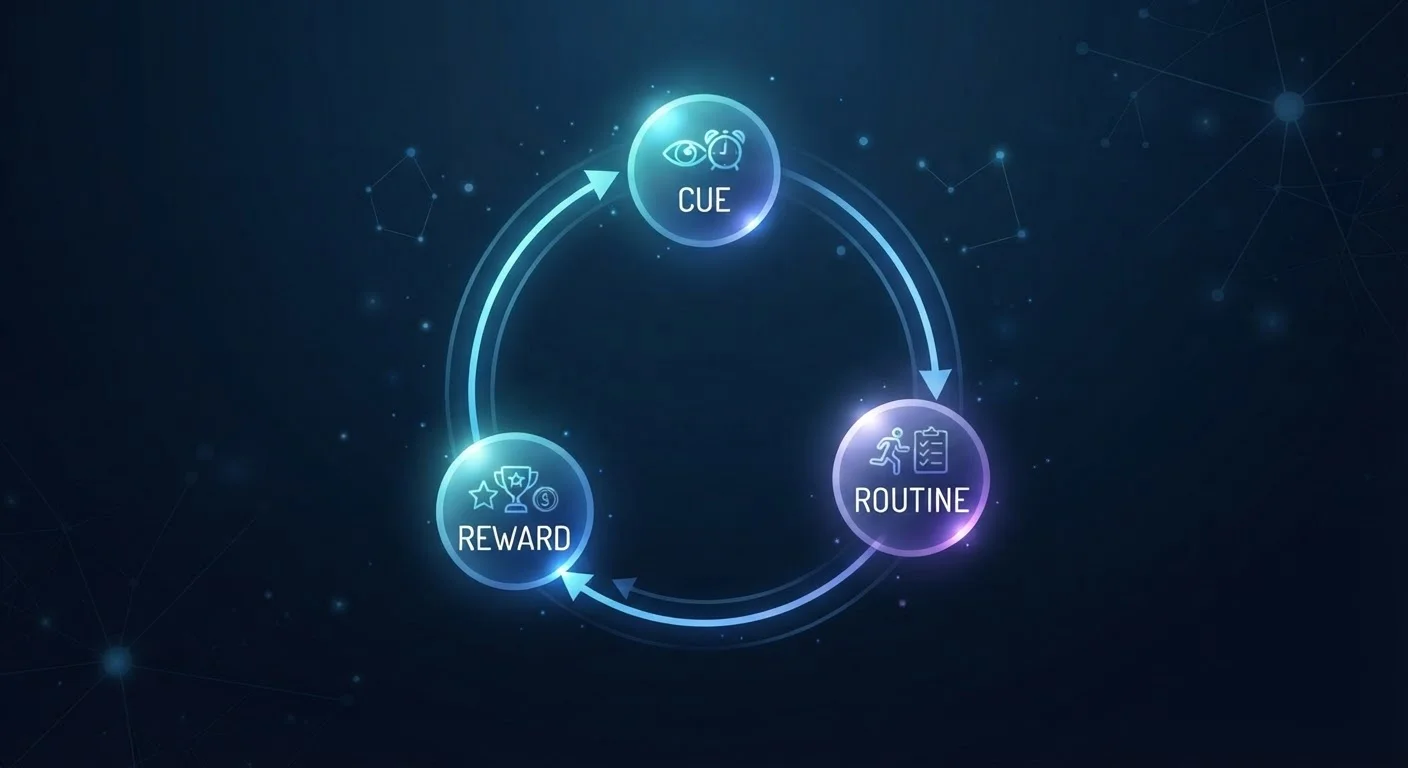
Photo: FeaturingHealth.net | Healthy Living Simplified editorial
Key Takeaways
- Every habit follows a three-part loop: cue, routine, and reward.
- Bad habits are difficult to break because the brain encodes them as efficient, automatic patterns.
- The most effective strategy is not elimination but substitution — keeping the cue and reward while changing the routine.
- Identifying your personal cues is the essential first step in any habit change effort.
- Environmental redesign is one of the most evidence-backed tools for disrupting unwanted habit loops.
What the Habit Loop Actually Is
In the early 1990s, MIT researchers discovered something striking: when rats learned to navigate a maze for a chocolate reward, their brains showed intense activity at first — but as the path became familiar, brain activity dropped dramatically. The behavior had become a habit, running on autopilot. This same architecture governs human behavior.
The habit loop, popularized in behavioral science literature and grounded in decades of neuroscience research, describes three linked stages:
- Cue: A trigger — internal (an emotion, a craving) or external (a place, a time, a person) — that tells the brain to initiate a routine.
- Routine: The behavior itself, which can be physical, mental, or emotional.
- Reward: The positive signal the brain receives that tells it this loop is worth remembering and repeating.
Each time you complete the loop, the neural pathway strengthens. The brain, always optimizing for efficiency, begins to anticipate the reward the moment the cue appears — a process called craving. That anticipation is what makes habits so self-sustaining. For a deeper look at how this plays out in everyday structure, see the science behind habit formation and daily structure.
Why Bad Habits Are Neurologically Sticky
The same efficiency that makes habits useful makes bad habits remarkably hard to dislodge. Once a habit loop is encoded in the basal ganglia, it doesn't disappear — it lies dormant, waiting for the cue. This is why people who quit smoking can feel strong urges years later when they encounter a familiar trigger like stress or a social setting where they used to smoke.
40–45%
Daily behaviors driven by habit, not conscious choice
A study by Duke University researchers, published in Psychological Science, estimated that roughly 40–45% of everyday actions are habitual rather than deliberately decided.
18–254 days
Range for a new behavior to become automatic
A study published in the European Journal of Social Psychology followed 96 participants and found that habit formation timelines vary widely depending on the behavior and the person.
Willpower is commonly offered as the solution, but research points to a fundamental problem: self-control is a finite cognitive resource. Studies on ego depletion suggest that resisting impulses repeatedly in a day leaves less mental capacity available for future decisions — meaning the strategy of white-knuckling through cravings tends to fail over time, especially under stress.
To understand the full neuroscience behind this resistance, why habits are so hard to break offers a detailed look at the brain mechanisms involved.
The Substitution Strategy: Keeping What Works
The most evidence-supported approach to habit change is not elimination but substitution. Because the cue and the reward are deeply embedded in the loop, attempting to remove them entirely usually fails. The more sustainable path is to keep the cue and the reward — and change only the routine.
Start With the Cue, Not the Behavior
For example: if the cue is mid-afternoon restlessness and the reward is a brief mental break, the routine of reaching for a sugary snack can be replaced with a short walk, a few minutes of stretching, or even cold water. The brain still gets its break; the harmful behavior is displaced. This same principle applies across many habit domains — including eating. How the habit loop drives food choices explores how this plays out specifically at mealtimes.
Practical steps for applying substitution:
- Identify the cue. For several days, log what you were doing, feeling, and where you were each time the unwanted habit arose.
- Isolate the actual reward. Ask what need the routine is meeting — relief, stimulation, social connection, comfort?
- Design an alternative routine that delivers the same core reward without the harmful behavior.
- Redesign your environment. Remove or alter cues where possible. Environmental changes reduce the cognitive load of resisting habits in the moment.
It's also worth considering the social dimension of habit change. The people around you can reinforce existing loops without either of you realizing it. How social circles shape our habits addresses this often-overlooked factor in lasting change.
For a broader foundation on building intentional routines, the Habit Formation hub brings together the research on what makes new behaviors stick.
This article is for informational purposes only and is not a substitute for professional medical or mental health advice. If you are struggling with compulsive behaviors or substance-related habits, please consult a qualified healthcare provider.
Frequently Asked Questions
The content on this site is for informational purposes only and is not a substitute for professional advice. Always consult a qualified professional for guidance specific to your situation.