
Micronutrients Across a Lifetime: How Needs Shift from Childhood to Older Adulthood

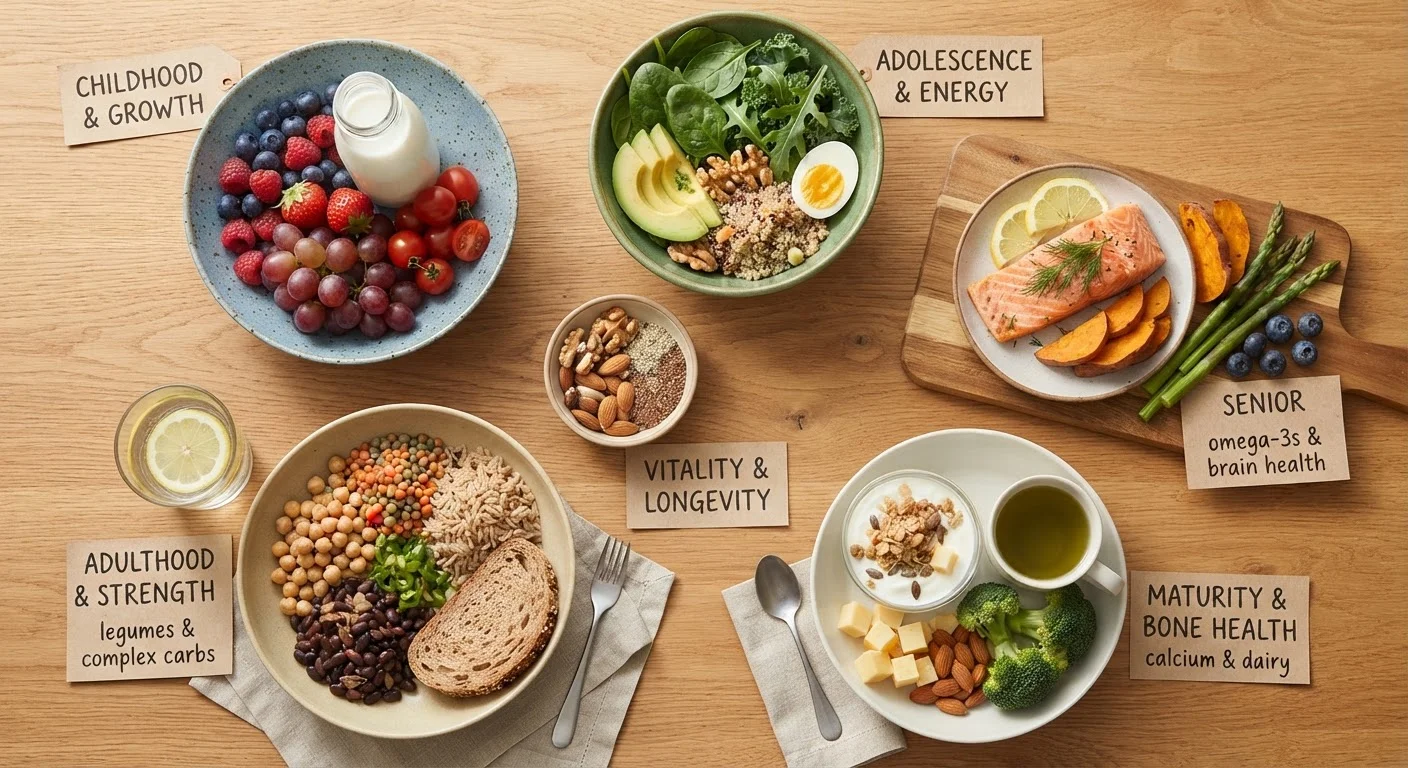
Photo: FeaturingHealth.net | Healthy Living Simplified editorial
Key Takeaways
- Vitamin and mineral requirements shift meaningfully at each life stage, not just in quantity but in which nutrients matter most.
- Childhood and adolescence prioritize calcium, iron, and vitamin D for growth and development.
- Older adults often need more vitamin B12, vitamin D, and calcium despite eating less overall.
- Absorption efficiency — not just dietary intake — determines whether needs are actually being met.
- A food-first approach covers most micronutrient needs across all life stages for healthy individuals.
Why Micronutrient Needs Aren't One-Size-Fits-All
Micronutrients — vitamins and minerals the body needs in relatively small amounts — play roles in virtually every biological process. For a thorough primer, see what vitamins and minerals actually do in the body. What that foundation doesn't cover is how those requirements shift across a lifetime.
The USDA and National Academies of Sciences establish Dietary Reference Intakes (DRIs) — recommended amounts that vary by age group and sex. These differences aren't arbitrary. They reflect real biological changes: how fast the body is growing, how efficiently the gut absorbs nutrients, how much the kidneys excrete, and which systems are under the greatest demand at a given stage of life.
Understanding those shifts helps you make more intentional food choices — and recognize when a life stage change might warrant a conversation with a healthcare provider or registered dietitian.
1,300 mg
Daily calcium needed by teens ages 9–18
According to the National Academies of Sciences, this is the highest calcium recommendation across all age groups.
40%
Older adults estimated low in vitamin D
Research published in nutrition and aging literature suggests a significant portion of older adults in the U.S. have insufficient vitamin D status.
2x
Iron gap: women vs. men in adulthood
Adult women of reproductive age require 18 mg of iron daily versus 8 mg for men, per established USDA Dietary Reference Intakes.
Childhood: Building the Foundation
From infancy through the early school years, the body is assembling systems that will last a lifetime. Bone mineralization, immune programming, and neurological development all depend on an adequate supply of specific micronutrients.
- Calcium and Vitamin D work together to build bone density. Children ages 1–3 need 700 mg of calcium daily; that rises to 1,000 mg for ages 4–8. Dairy foods, fortified plant milks, and leafy greens are primary sources. Vitamin D — obtained through sunlight exposure and fortified foods — enables calcium absorption in the gut.
- Iron is critical for cognitive development and oxygen transport. Toddlers who shift from breast milk or formula to solid foods are at particular risk of falling short. Iron-rich options include lean meats, beans, and iron-fortified cereals.
- Zinc supports immune function and normal growth. See a detailed look at zinc and other trace minerals for food sources and context.
Make Iron-Rich Foods a Daily Habit for Young Children
Adolescence: Growth Demands Peak Intake
The teenage years bring some of the highest micronutrient requirements across the entire lifespan. A growth spurt, hormonal shifts, and the onset of menstruation in adolescent girls all drive demand upward simultaneously.
- Calcium requirements jump to 1,300 mg per day for ages 9–18 — the single highest recommendation across all age groups. Adolescence is the primary window for building peak bone mass, making this a critical period.
- Iron needs rise for adolescent girls with the start of menstruation: 15 mg per day compared to 8 mg for boys of the same age. Animal-source iron (heme iron) from meat and poultry is more readily absorbed than plant-source iron.
- Folate supports rapid cell division during growth. It also becomes essential for adolescent girls of reproductive age, since adequate folate before and during early pregnancy significantly reduces the risk of neural tube defects.
Pair plant-based iron sources — like beans or spinach — with a vitamin C-rich food at the same meal, such as bell peppers or citrus. This combination can meaningfully improve non-heme iron absorption.
For older adults concerned about B12, look for fortified cereals or fortified plant milks as a daily dietary source — the crystalline form of B12 in these foods is absorbed without depending on stomach acid.
Adulthood: Maintenance and Prevention
For most healthy adults aged 19–50, the primary micronutrient goal shifts from building systems to maintaining them. Recommended intakes for many nutrients stabilize, though some sex-specific differences remain significant.
- Iron requirements for women remain elevated at 18 mg per day through menopause, while men need only 8 mg. This is among the most significant sex-based differences in adult nutrition.
- Magnesium supports muscle function, blood pressure regulation, and blood sugar control — an increasingly relevant concern as adults age. Whole grains, nuts, seeds, and dark leafy greens are reliable sources.
- B vitamins, including B6, B12, and folate, support energy metabolism and cardiovascular health. Most adults meet these needs through a varied diet, though people following plant-based diets should monitor B12 specifically, since it occurs naturally only in animal foods.
Adults can use a structured self-assessment approach to identify potential gaps. The micronutrient gap self-assessment is a useful starting point. Just as micronutrient needs evolve, so do macronutrient requirements across life stages.
Plant-Based Diets Require B12 Planning at Every Age
Older Adulthood: Absorption Changes Everything
After age 50 — and more significantly after 70 — physiological changes alter both how the body uses micronutrients and how efficiently it absorbs them. Calorie needs often decrease, yet micronutrient requirements for several key nutrients actually increase.
- Vitamin B12 absorption declines with age because the stomach produces less hydrochloric acid, which is needed to separate B12 from food proteins. The recommended intake stays at 2.4 mcg, but many older adults benefit from crystalline B12 (found in fortified foods or supplements) since that form bypasses the need for stomach acid.
- Vitamin D requirements rise to 800 IU (20 mcg) per day for adults over 70, up from 600 IU for younger adults. Skin synthesis of vitamin D also becomes less efficient with age, increasing reliance on dietary sources and fortified foods.
- Calcium needs increase to 1,200 mg per day for women over 50 and all adults over 70, supporting bone health as natural bone remodeling slows.
Special Populations Need Individualized Guidance
Older adults are also more likely to take medications that interact with specific nutrients, making it especially important to review supplement use with a healthcare provider.
Putting It Into Practice: Food-First Strategies
Across every life stage, a varied, whole-food diet remains the most reliable way to meet micronutrient needs. The everyday eater's reference to essential micronutrients provides a practical lookup for key vitamins and minerals and their food sources.
A few strategies apply broadly:
- Prioritize variety over perfection. No single food supplies every micronutrient. Rotating vegetables, proteins, and whole grains throughout the week naturally covers more ground than eating the same foods daily.
- Account for absorption, not just intake. Pairing vitamin C-rich foods with plant-based iron improves iron absorption. Consuming calcium-rich foods spread across meals improves uptake compared to one large serving.
- Revisit your plate at life stage transitions. Pregnancy, menopause, and reaching older adulthood are logical checkpoints to reassess dietary patterns with a registered dietitian.
Just as sleep architecture shifts meaningfully across adulthood, so does nutritional biology. Treating dietary needs as fixed is one of the most common and correctable gaps in everyday health planning.
USDA Dietary Reference Intakes Tables
The official reference tables from the USDA listing recommended intakes for vitamins and minerals by age group and sex — the foundation for understanding how needs shift across life stages.
MyPlate for Life Stages
The USDA's MyPlate resource includes life-stage-specific guidance for toddlers, teens, pregnant individuals, and older adults to help translate nutrient recommendations into food choices.
Everyday Eater's Reference to Essential Micronutrients
A quick-lookup companion covering key vitamins and minerals, their primary roles, and the main food sources — useful for translating life-stage needs into everyday meal planning.
This article is for informational and educational purposes only and is not a substitute for professional medical or dietary advice. Consult a qualified healthcare provider or registered dietitian for guidance specific to your health needs.
The content on this site is for informational purposes only and is not a substitute for professional advice. Always consult a qualified professional for guidance specific to your situation.