
How Long Does It Actually Take to Break a Habit?

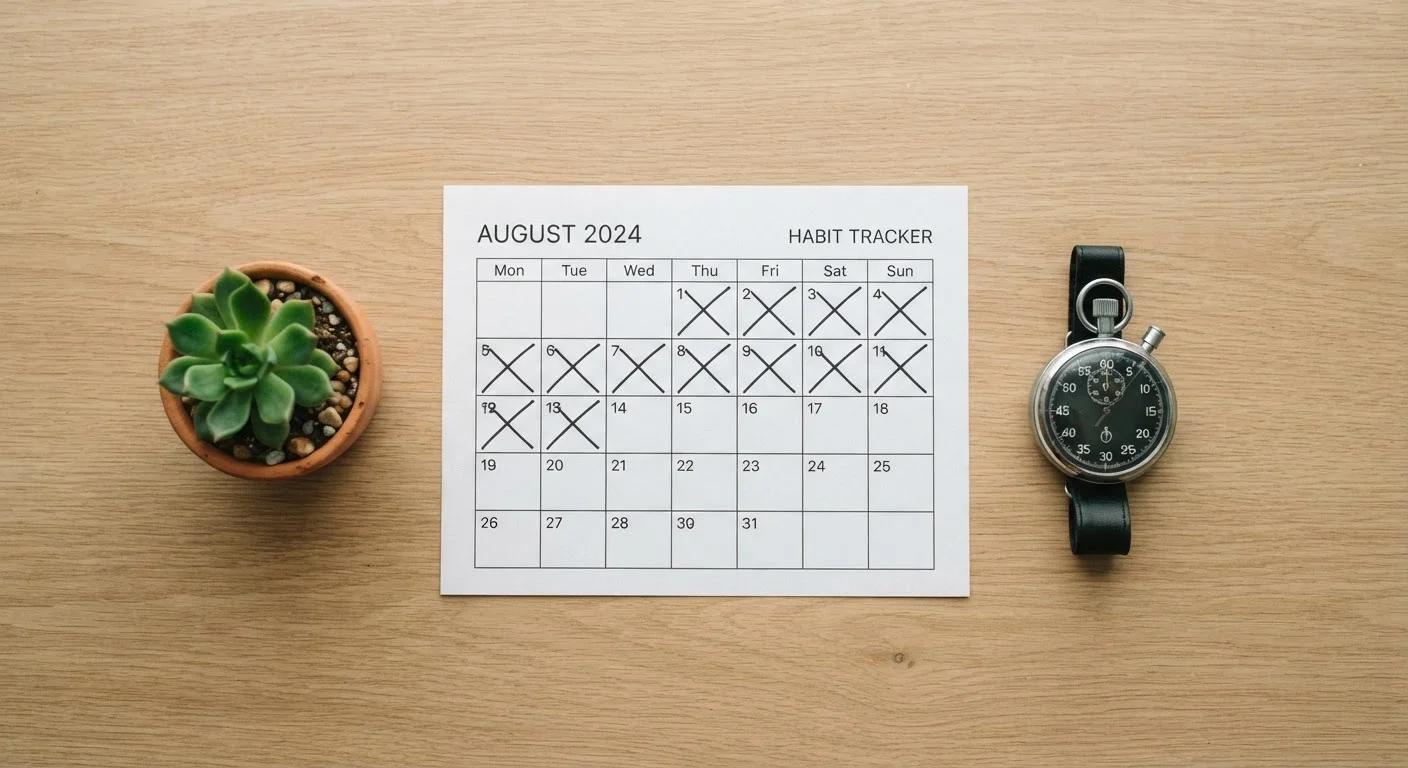
Photo: FeaturingHealth.net | Healthy Living Simplified editorial
Key Takeaways
- The '21-day rule' for breaking habits is not supported by rigorous scientific evidence.
- Research suggests habit change typically takes anywhere from 18 to 254 days, depending on the behavior.
- Missing a single day does not significantly derail the habit-change process.
- Replacing a habit with a new behavior is more effective than simply trying to eliminate the old one.
- Consistency in context — same cue, same time — accelerates the unlearning process.
Where the '21-Day Rule' Actually Came From
The claim that it takes 21 days to break or build a habit has circulated in self-help culture for decades. Its origins trace back to a 1960 observation by plastic surgeon Maxwell Maltz, who noticed that patients took roughly three weeks to adjust to changes in their appearance after surgery. That personal clinical note was gradually transformed — through repetition in popular books and motivational content — into a universal rule about human behavior. It was never a controlled study, and it was never about habits at all.
This matters because false timelines create false expectations. When someone tries to quit a habit and still feels the pull after 21 days, they may conclude they've failed or that they're uniquely weak-willed. Neither is true. For a deeper look at how these myths persist, see habit-formation myths that may be holding you back.
Myth
It takes exactly 21 days to break a habit.
Fact
Research shows habit change typically takes between 18 and 254 days, with a median of around 66 days — and varies significantly by person and behavior.
The 21-day figure originated from a misapplied surgical observation, not behavioral science. Controlled research on habit automaticity shows wide variation across individuals and behavior types. Expecting change in three weeks sets most people up for premature disappointment.
Myth
Breaking a habit means eliminating the behavior entirely through willpower.
Fact
Habits are rarely erased; they are more effectively replaced by redirecting the existing cue-routine-reward loop to a new behavior.
Neuroscience research indicates that habitual behavior patterns persist in the brain's basal ganglia even after long periods of inactivity. Suppression alone tends to deplete cognitive resources without dismantling the underlying loop. Substituting a new response to the same cue is a more durable and evidence-supported approach.
Myth
Missing a day resets your progress entirely.
Fact
A single missed day has little to no measurable effect on long-term habit formation, according to research by Lally and colleagues.
The UCL study found that occasional lapses did not significantly disrupt the overall habit-building curve. Treating a slip as a catastrophic failure often causes people to abandon their efforts entirely — a pattern sometimes called the 'what-the-hell effect' in behavioral research. Consistency over weeks and months matters far more than any single day.
Myth
Motivation is the primary driver of successful habit change.
Fact
Environmental design and repetition are stronger predictors of lasting habit change than motivation alone.
Motivation fluctuates daily and is an unreliable foundation for long-term behavior change. Behavioral scientists consistently find that modifying the environment — removing cues for unwanted behaviors, making desired alternatives more accessible — produces more durable results than relying on sustained willpower or enthusiasm.
What the Research Actually Shows
A frequently cited study published in the European Journal of Social Psychology by Phillippa Lally and colleagues at University College London tracked 96 participants attempting to build new health behaviors over 12 weeks. The researchers found that automaticity — the point at which a behavior feels nearly effortless — was reached somewhere between 18 and 254 days, with a median of around 66 days. Critically, the curve was not linear: progress was fastest in the early weeks and gradually plateaued.
66 days
Median time to habit automaticity
According to a University College London study published in the European Journal of Social Psychology (Lally et al., 2010).
18–254 days
Full observed range for habit formation
The same UCL study found wide individual variation depending on behavior complexity and personal factors.
What this tells us is that habit timelines are highly individual. The type of behavior matters (drinking a glass of water versus doing 50 sit-ups), as does the person's history, motivation, and environment. To understand why the brain resists change so persistently, explore what neuroscience says about breaking habits.
Practical Strategies That Align With the Evidence
Understanding the real timeline is empowering — but it's most useful when paired with strategies that work. Here's what behavioral research consistently supports:
- Substitute, don't just suppress. The brain's habit circuitry doesn't simply erase a routine — it can be redirected. Identifying the cue that triggers an unwanted behavior and consciously responding with a different routine is more effective than trying to resist the urge entirely. Learn more about this mechanism in our guide to the habit loop and why bad habits are so hard to break.
- Keep the context consistent. Habits form and dissolve in response to environmental cues. Performing a replacement behavior in the same time and place as the old one leverages existing triggers rather than fighting them.
- Don't catastrophize a slip. The UCL research found that missing a single day had no meaningful effect on long-term habit formation. Treating lapses as data — rather than failure — keeps momentum intact.
- Anchor new behaviors to existing routines. Also called habit stacking, this technique pairs the new behavior with something you already do automatically, reducing the cognitive effort required. The science behind habit formation and daily structure explains why structured days make this especially effective.
Avoid Rigid 'Cold Turkey' Expectations
Habit dropout is also common and well-documented. If you've struggled to sustain changes in the past, understanding the structural and psychological reasons behind that pattern can be just as important as knowing the timeline. See why many people drop healthy habits within weeks for a closer look.
This article is for general informational and educational purposes only and is not a substitute for professional medical or psychological advice. If you are dealing with compulsive behaviors, addiction, or significant mental health challenges related to habit change, please consult a qualified healthcare professional.
The content on this site is for informational purposes only and is not a substitute for professional advice. Always consult a qualified professional for guidance specific to your situation.