
Free Weights or Machines: Understanding the Real Trade-Offs

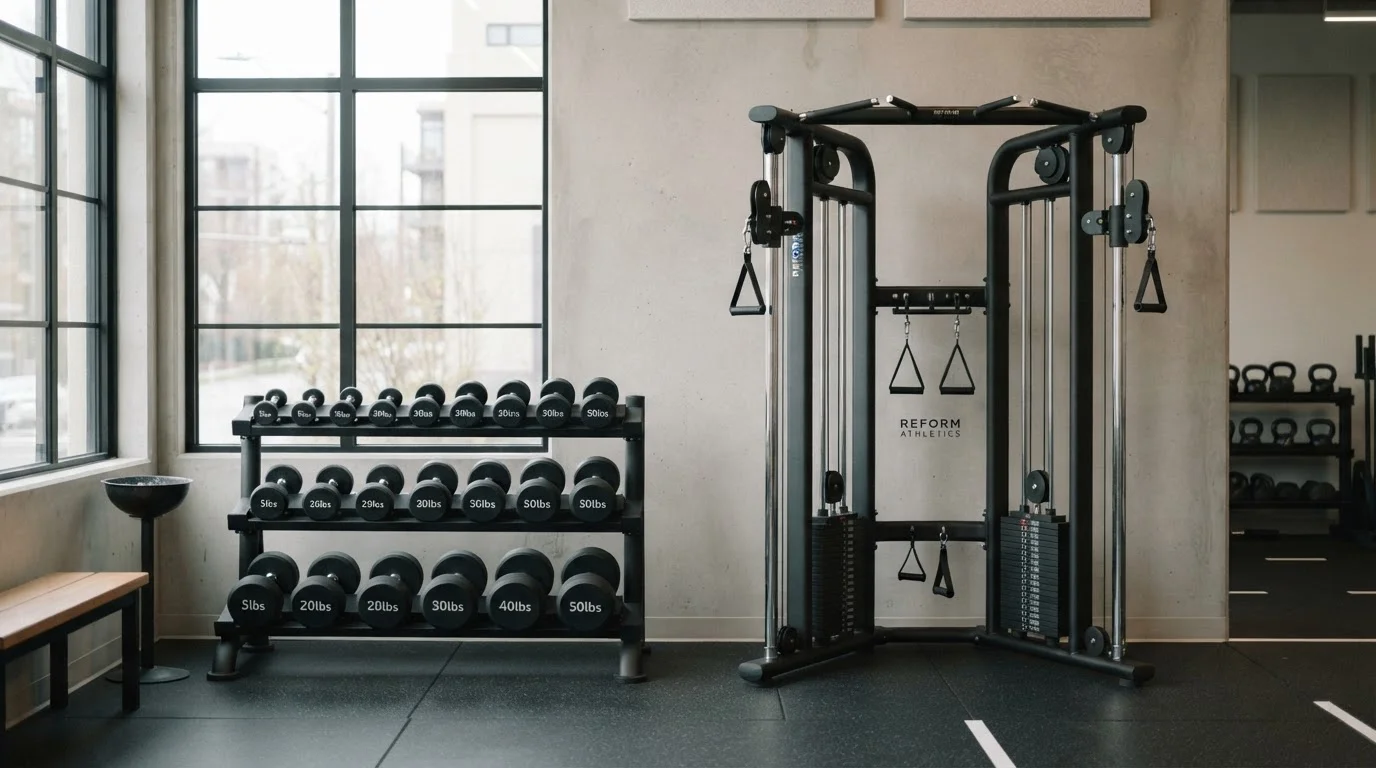
Photo: FeaturingHealth.net | Healthy Living Simplified editorial
Key Takeaways
- Free weights recruit more stabilizer muscles and transfer better to functional, real-world movements.
- Machines reduce joint stress and lower injury risk during rehabilitation or early training stages.
- Neither tool is universally superior — goal, experience level, and injury history should guide the choice.
- Combining both approaches is supported by research as an effective strategy for balanced muscle development.
- Consult a qualified fitness professional or physical therapist before starting a new program, especially with existing injuries.
What the Research Actually Says
The debate between free weights and machines is one of the most persistent in gym culture, but the scientific literature offers a more nuanced picture than either camp typically acknowledges. Both modalities produce meaningful strength and hypertrophy gains — the differences lie in how those adaptations occur and which populations benefit most from each.
A frequently cited area of distinction is muscle activation. Studies using electromyography (EMG) — which measures electrical activity in muscles — have found that free weight exercises tend to produce greater activation in stabilizing muscles surrounding a joint compared to machine equivalents. A barbell squat, for example, demands significant coordination from core musculature, hip stabilizers, and ankle plantar flexors in a way a leg press machine does not replicate. That additional neuromuscular demand is a genuine training stimulus, not just added difficulty for its own sake.
Machines, by contrast, excel at isolating specific muscles with reduced demand on surrounding tissue. This can be advantageous when fatigue or injury limits a lifter's ability to maintain safe form under a free weight load. For evidence-based context on how these principles apply differently across populations, see our article on why muscle physiology varies between individuals.
| Criterion | Free Weights | Resistance Machines |
|---|---|---|
| Stabilizer muscle activation | High — demands significant stabilization | Low — movement path is guided |
| Learning curve | Steeper — technique-dependent | Gentler — suitable for beginners |
| Injury risk (beginner) | Higher if form breaks down | Lower due to controlled range |
| Muscle isolation | Limited — multiple muscles involved | High — targets specific muscles |
| Functional movement transfer | Strong — mimics real-world loading | Weaker — fixed plane movement |
| Solo training safety | Riskier without a spotter | Generally safer without a spotter |
| Equipment cost and space | Lower cost, compact options available | Higher cost, requires more space |
Injury Risk, Stability, and Learning Curve
One of the most practical considerations — particularly for men returning from injury or beginning resistance training after a long break — is injury risk relative to training output. Free weights demand greater proprioceptive awareness (your body's ability to sense its position in space) and technique precision. When those elements are underdeveloped, the margin for injury widens.
Machines constrain movement to a fixed plane, which reduces technique variability and with it, certain injury vectors. This is particularly relevant at the shoulder, knee, and lower back — areas that account for a disproportionate share of gym-related injuries. However, fixed-plane movement can also impose unnatural joint angles on some individuals whose anatomy doesn't match the machine's design — a lesser-discussed limitation worth flagging.
A Note on Fixed-Plane Machine Design
The practical takeaway for most lifters: free weights have a steeper learning curve that pays off over time; machines offer a safer entry point and a reliable tool for targeted work at any training level. If managing a pre-existing orthopedic condition, always seek clearance from a physical therapist before selecting either approach.
Building a Smarter Program: When to Use Each
The most evidence-informed approach is rarely an either/or decision. Research supports integrating both modalities within a well-structured program. A practical framework used by many strength coaches positions compound free weight lifts — such as deadlifts, bench press, and overhead press — as the primary load drivers, with machine-based exercises used as accessory work to address lagging muscle groups or manage fatigue safely late in a session.
~8–10%
Greater stabilizer activation with free weights
EMG research published in the Journal of Human Kinetics found meaningfully higher stabilizer muscle activation during free weight exercises compared to machine equivalents for matched loads.
No significant difference
Hypertrophy outcomes: free weights vs. machines
A 2020 systematic review in the Journal of Strength and Conditioning Research found comparable hypertrophy gains between modalities when volume and effort are equated.
Beginners often benefit from spending the first several weeks of a program on machines to build foundational movement confidence before introducing barbell or dumbbell work. Intermediate and advanced lifters may use machines strategically to add volume without placing additional neurological demand on the central nervous system during high-frequency training blocks.
For those weighing strength training more broadly against other fitness modalities, our breakdown of aerobic fitness versus muscular strength covers the concurrent training evidence in depth. The core principle applies here too: trade-offs exist, but smart programming often minimizes them.
This article is for general informational purposes only and does not constitute medical or professional fitness advice. Consult a qualified healthcare provider or certified strength and conditioning professional before starting or modifying any exercise program.
The content on this site is for informational purposes only and is not a substitute for professional advice. Always consult a qualified professional for guidance specific to your situation.