
Rigid Schedules vs. Flexible Routines: Which Supports Well-Being Better?

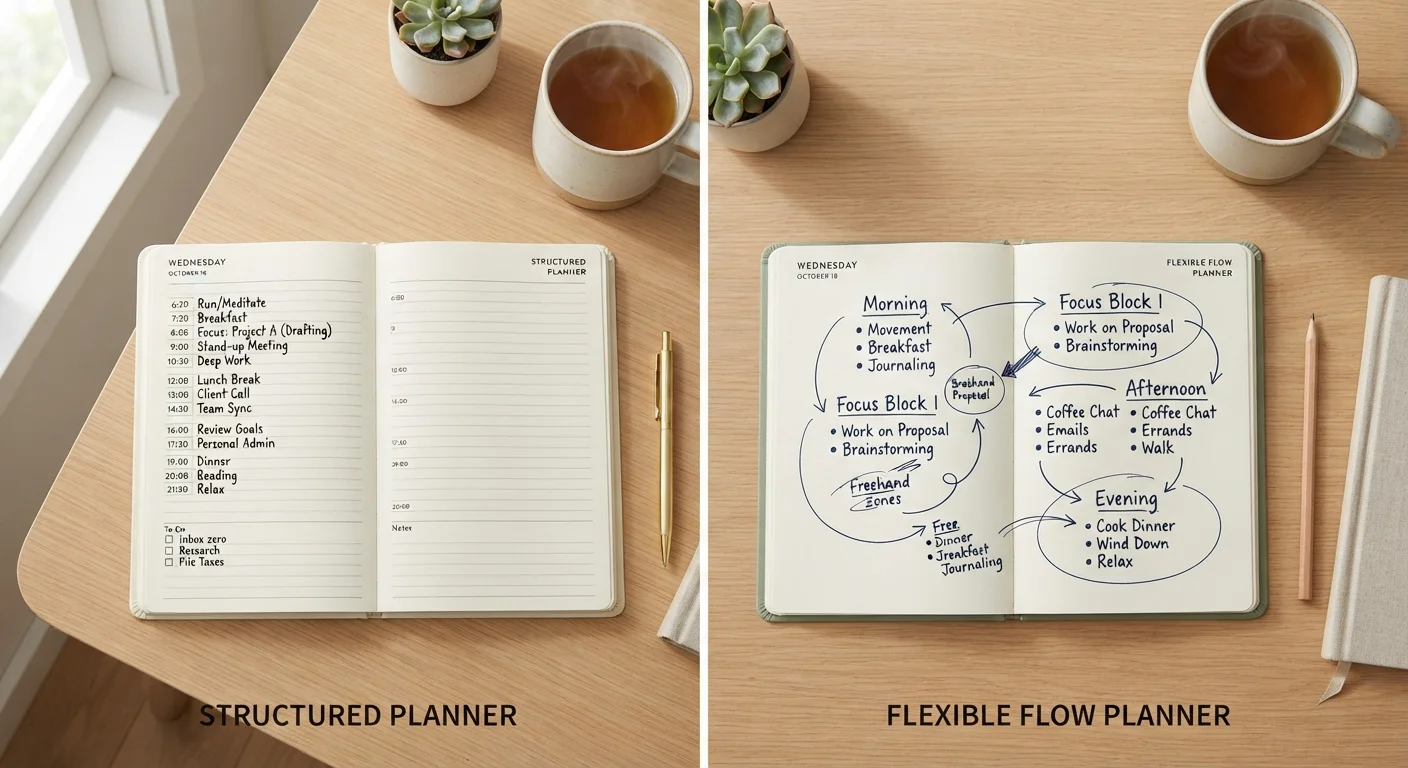
Photo: FeaturingHealth.net | Healthy Living Simplified editorial
Key Takeaways
- Consistent structure — not perfect scheduling — is what research links to better sleep, stress regulation, and habit formation.
- Rigid schedules reduce decision fatigue but can increase stress when disrupted by real-life variability.
- Flexible routines preserve the benefits of regularity while allowing adaptation without guilt or derailment.
- A hybrid approach — anchoring key daily behaviors while allowing timing flexibility — suits most adults best.
- Circadian biology strongly favors consistent sleep and meal timing, even within otherwise flexible days.
Why Structure Matters for Health — and What Kind Actually Counts
The instinct to organize your day isn't just a productivity trick — it has a measurable impact on physical and mental health. Research consistently shows that predictable daily patterns support better sleep quality, lower perceived stress, and stronger habit maintenance. But the critical distinction is between structure and rigidity. These are not the same thing.
Daily routines shape key biological systems, including the circadian rhythm — your body's roughly 24-hour internal clock — which regulates sleep, hunger, hormone release, and immune function. When your daily timing is erratic, these systems are disrupted. When it's consistent, even loosely, they operate more efficiently.
A rigid schedule pins every activity to a precise time slot. A flexible routine anchors habits to sequences or contextual cues rather than clock times. Both deliver a degree of structure; they differ in how much adaptation they allow — and that difference matters depending on your life circumstances and temperament.
| Criterion | Rigid Schedules | Flexible Routines |
|---|---|---|
| Structure type | Fixed clock times for each activity | Habit anchors and behavioral sequences |
| Decision fatigue reduction | High — eliminates daily timing decisions | Moderate — reduces decisions, allows adaptation |
| Resilience to disruption | Low — breaks under variability | High — adapts without derailing |
| Circadian support | Strong when consistently maintained | Good if sleep/meal timing stays regular |
| Stress risk | Higher if schedule breaks frequently | Lower — built-in tolerance for change |
| Best evidence context | Chronic condition management, clinical settings | General habit formation, variable lifestyles |
| Long-term sustainability | Moderate — depends on life stability | Higher for most adults across varied weeks |
The Case for Rigid Schedules — and Their Limits
Time-blocked schedules have real, evidence-backed advantages. By removing the moment-to-moment decision of when to exercise, eat, or sleep, they reduce decision fatigue — a documented phenomenon where repeated choices erode self-regulatory capacity over the course of a day. For people managing chronic health conditions, structured timing can be medically significant: consistent meal timing supports metabolic regulation, and consistent sleep timing is directly tied to circadian health.
However, highly structured days carry their own trade-offs. When life inevitably interrupts a rigid timetable — a work emergency, a sick child, an unexpected social obligation — people who rely heavily on fixed scheduling can experience disproportionate stress or a sense of failure that undermines the entire routine. Behavioral research suggests that all-or-nothing thinking around schedules is one of the most common reasons healthy habits collapse.
~40%
Daily behaviors that are habitual
A widely cited study published in the Proceedings of the National Academy of Sciences estimated that roughly 40% of daily actions are habits, not conscious decisions — highlighting why structure shapes health so significantly.
66 days
Average time to form a new habit
Research by Phillippa Lally and colleagues at University College London found that, on average, a new behavior takes 66 days to become automatic — with considerable individual variation.
~1.5x
Greater sleep irregularity-mood link
Studies on social jetlag — the mismatch between biological and social sleep timing — have associated irregular sleep schedules with notably higher rates of mood disturbance and fatigue.
The practical risk is that rigid scheduling works brilliantly in stable conditions and poorly under variability — and most adult lives involve considerable variability.
The Case for Flexible Routines — and How to Make Them Stick
Flexible routines preserve the structural benefits of regularity while building in resilience. Instead of "exercise at 7:00 AM," a flexible routine frames the habit as "exercise before I start work." Instead of a fixed bedtime, it means maintaining a consistent wind-down sequence that signals sleep, regardless of whether it starts at 9:45 or 10:30 PM.
This approach aligns with how habit formation actually works. Habits are encoded as cue-routine-reward loops; the cue doesn't have to be a clock time — it can be an event, a location, or a preceding behavior. Linking a new habit to a stable existing cue (making coffee, sitting down at your desk, brushing your teeth) tends to produce more durable behavior change than scheduling it at a specific hour that shifts with your week.
Structuring your mornings around behavioral anchors rather than a fixed timetable is one practical application of this principle. The goal is a sequence that travels with you, not a schedule that breaks when your alarm doesn't go off.
Consistency Matters More Than Perfection
Finding Your Balance: What the Evidence Actually Recommends
Most behavioral health researchers don't frame this as a binary choice — the practical consensus points toward a hybrid model. Identify the two or three daily behaviors most critical to your health (sleep timing, physical movement, and meals are the most evidence-supported), and protect their consistency without necessarily fixing their clock time. For everything else, allow yourself a flexible window.
Consistent sleep timing is one area where research most clearly favors regularity over flexibility — irregular sleep schedules have been associated with reduced cognitive performance and mood disruption even when total sleep hours are adequate. Similarly, structured meal timing versus flexible eating carries meaningful metabolic implications worth examining for your specific situation.
The most sustainable daily structure is one that you can maintain across a bad week, not just optimize for a perfect one. If your current routine falls apart every time plans change, that's a signal to build in more flexibility — not to try harder at rigidity.
This article is for general informational and educational purposes only and does not constitute medical advice. If you have a health condition or specific concerns about your daily routine, please consult a qualified healthcare professional.
The content on this site is for informational purposes only and is not a substitute for professional advice. Always consult a qualified professional for guidance specific to your situation.